Bectron® printed-electronics inks discontinued: VFP silver, carbon and dielectric alternatives
31 October 2026 · Values re-checked against the 13 VFP Ink Technologies technical data sheets, one per grade, on 2026-10-31
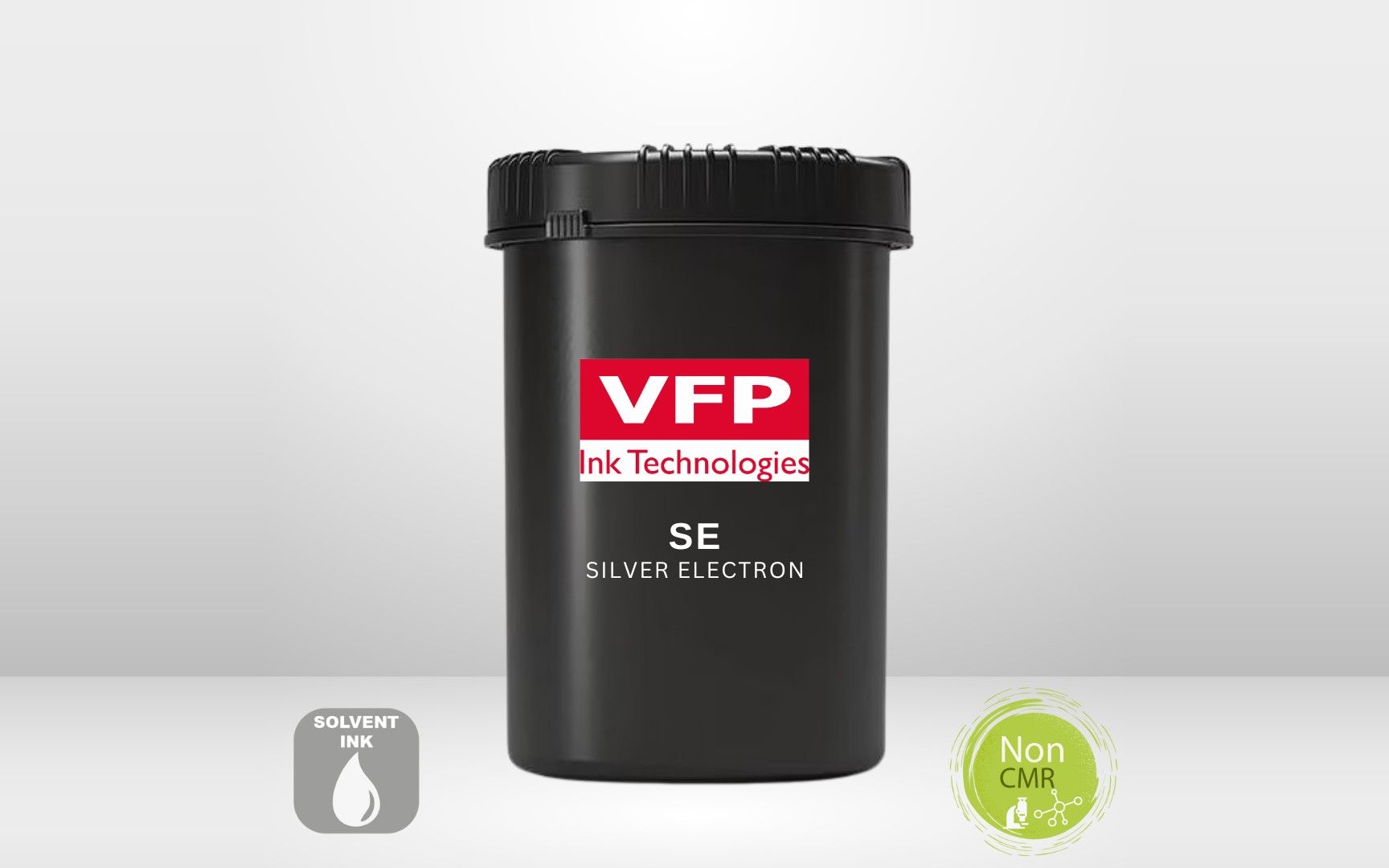
ELANTAS discontinued the Bectron® printed-electronics inks in September 2026. We work with VFP Ink Technologies: for the Bectron silver, carbon and UV-insulator inks there is a VFP grade to trial; for the Bectron EL inks and conductive adhesives there is none. The lowest silver resistivity VFP lists is ≤ 10 mΩ/sq/mil. There is no one-to-one replacement: send us the Bectron code and we name the nearest VFP grade for a trial, and you qualify it on your own substrate.
Short answer: what was discontinued and what to trial instead
| Item | Status |
|---|---|
| Bectron® printed-electronics inks (CG, CP, DP, EL, GP series) | Discontinued by ELANTAS in September 2026 |
| Line to trial instead (silver, carbon, UV insulator) | VFP Ink Technologies functional inks for screen printing and flexography |
| Cross-reference Bectron code → VFP code | By code for the silver, carbon and UV-insulator inks: see the code table below. Partial fits and the other series by function and process. |
| Qualification | Preliminary test on your substrate, which VFP calls “essential” (SECTR-I01 TDS, p. 1) |
| Lead time for VFP inks | 5–15 business days from order |
Which Bectron series are affected
These are the 33 Bectron printed-electronics codes in our product database. The code table below names a VFP grade for the codes that have one; for any other code, send us the TDS of the Bectron ink you print and we compare it with VFP data.
| Series | Codes |
|---|---|
| CG | 5660, 5661 |
| CP | 6612, 6618, 6619, 6662, 6663, 6666, 6667, 6668, 6669, 6671, 6680, 6681, 6690 |
| DP | 8442, 8443, 8444, 8445, 8446, 8480, 8481, 8491 |
| EL | 7001, 7002, 7003, 7030, 7080, 7090 |
| GP | 9552, 9553, 9555, 9580 |
Bectron® code → VFP grade to trial
Send us the Bectron® code and we name the nearest VFP grade, then help you qualify it with a print trial with your screen on your substrate.
| If you used (Bectron®) | For | VFP grade to trial | What differs |
|---|---|---|---|
| CP 6663 | Silver, membrane switch | SELEC | Same class (≤ 15 mΩ/sq/mil); 120 °C/5 min instead of 10 min |
| CP 6662, CP 6669 | Silver, 10 mΩ/sq/mil | SELEC or LV-SELEC; SECTR-I01 for ≤ 10 | SELEC ≤ 15, LV-SELEC ≤ 12; SECTR-I01 is two-component, a new development |
| CP 6667, CP 6668 | Silver, fine lines / fast cure | SELEC or LV-SELEC | LV-SELEC: 150 °C 3 min or 120 °C 5 min; ≤ 12 vs 10 |
| CP 6666 | Silver on glass | SE | Hotter cure: 130 °C/30 min or 150 °C/10 min |
| CP 6680 | Thermoformable silver (IME) | SES | Cures at 130–150 °C, or during forming at 200–300 °C, not at 120 °C. After thermoforming on polycarbonate: < 300 mΩ/sq/mil (Bectron: 25). |
| GP 9552, GP 9553 | Carbon | CEL001 or CEL003 | 120 Ω/sq/mil instead of 40; fits contacts and track protection |
| DP 8442, DP 8446, DP 8443 | UV insulator, green or blue | ECV003 (green) | No blue grade; broadband UV over 300 mJ/cm² (Bectron: over 600) |
| DP 8444, DP 8445, DP 8481 | UV insulator, clear | ECV004 (clear) | Broadband UV over 300 mJ/cm² (Bectron: over 600) |
There is also no VFP grade for the Bectron® UV-curing silver, thermoformable insulator and carbon, high-temperature insulator or carbon for glass. VFP makes no copper ink or transparent conductor, and SES is its only thermoformable grade.
Bectron values from the ELANTAS printed-electronics brochure; VFP values from the VFP datasheets. Units: Bectron writes Ω/sq/mil, VFP mΩ/sq/mil; 0.010 Ω/sq/mil = 10 mΩ/sq/mil. Partial fit only, ask for the detail: CP 6681 (silver for PC films), CP 6690 (high-temperature silver), the silver/carbon blends CP 6612, 6618, 6619. Carbon pairing: CEL001 over SE, SETF or FSE; CEL003 over SELEC or LV-SELEC.
VFP ink families by function
| Function | VFP range | Members | Source |
|---|---|---|---|
| Silver conductive inks | Silver Electron | SE, SETF, SELEC, LV-SELEC, SES, FSE, SECTR-I01 | TDS of each grade |
| Carbon resistive layers printed over VFP silver: CEL001 over SE, SETF and FSE; CEL003 over SELEC and LV-SELEC | Carbon Electron | CEL001, CEL003 | CEL001 and CEL003 TDS |
| UV-cured dielectric varnishes, chemically compatible with the Silver Electron range | Encapsulating | ECV003, ECV004 | ECV003 and ECV004 TDS |
| Piezoelectric layers on PET, printed over VFP silver | Piezo Electron | PEUV (UV), PESOL (solvent) | PEUV and PESOL TDS |
Silver conductive inksSilver Electron
- Members
- SE, SETF, SELEC, LV-SELEC, SES, FSE, SECTR-I01
- Source
- TDS of each grade
Carbon resistive layers printed over VFP silver: CEL001 over SE, SETF and FSE; CEL003 over SELEC and LV-SELECCarbon Electron
- Members
- CEL001, CEL003
- Source
- CEL001 and CEL003 TDS
UV-cured dielectric varnishes, chemically compatible with the Silver Electron rangeEncapsulating
- Members
- ECV003, ECV004
- Source
- ECV003 and ECV004 TDS
Piezoelectric layers on PET, printed over VFP silverPiezo Electron
- Members
- PEUV (UV), PESOL (solvent)
- Source
- PEUV and PESOL TDS
VFP states REACH compliance, RoHS 3 for its silver and carbon inks, and that all 13 printed-electronics grades are non-CMR. A REACH declaration of conformity and the SDS come with each order.
Matching by process: silver inks
All values are from the VFP technical data sheet of each ink, except the NIR times for SELEC, LV-SELEC and FSE and the FSE anilox volume, which are from VFP’s printed-electronics presentation (April 2026). Resistivity is in mΩ/sq/mil.
| Ink | Print method | Mesh (threads/cm) | Squeegee | Oven cure | NIR cure | Resistivity | Substrates named by VFP |
|---|---|---|---|---|---|---|---|
| SE | Screen | 79–120 | 65 Shore A | 150 °C/10 min or 130 °C/30 min | not stated | ≤ 15 | Paper-cardboard, PVC, PET, polycarbonate, treated polyester, glass, polyimide |
| SETF (thin film) | Screen | 79–120 | 65 Shore A | 150 °C/10 min or 130 °C/30 min | 4 s | ≤ 150 | As SE |
| SES (stretchable) | Screen | 77–90 | 65 Shore | 150 °C/10 min or 130 °C/30 min | 2 s | < 10 on PET; < 50 after 20 % elongation on TPU | PET, polycarbonate, polyurethane |
| SELEC (low energy cure) | Screen | 79–120 | 65 Shore A | 150 °C/3 min or 120 °C/5 min | 2 s | ≤ 15 | Paper-cardboard, PET, treated polyester |
| LV-SELEC (low viscosity) | Screen | 79–120 | 65 Shore A | 150 °C/3 min or 120 °C/5 min | 2 s | ≤ 12 | As SELEC |
| FSE | Flexography, anilox 12–16 BCM | 79–120 | 65 Shore A | 150 °C/10 min or 120 °C/30 min | 2 s | ≤ 10 | Paper-cardboard, PET, polycarbonate, treated polyester, glass, polyimide |
| SECTR-I01 (2-component) | Screen | 79–120, polyester or stainless steel | Polyurethane, Shore 65 | 120 °C/5 min | not stated | ≤ 10 | Untreated and TCA-treated PET, paper; PC, polyimide or PVC depending on the TDS revision: confirm with VFP |
SEScreen
- Mesh (threads/cm)
- 79–120
- Squeegee
- 65 Shore A
- Oven cure
- 150 °C/10 min or 130 °C/30 min
- NIR cure
- not stated
- Resistivity
- ≤ 15
- Substrates named by VFP
- Paper-cardboard, PVC, PET, polycarbonate, treated polyester, glass, polyimide
SETF (thin film)Screen
- Mesh (threads/cm)
- 79–120
- Squeegee
- 65 Shore A
- Oven cure
- 150 °C/10 min or 130 °C/30 min
- NIR cure
- 4 s
- Resistivity
- ≤ 150
- Substrates named by VFP
- As SE
SES (stretchable)Screen
- Mesh (threads/cm)
- 77–90
- Squeegee
- 65 Shore
- Oven cure
- 150 °C/10 min or 130 °C/30 min
- NIR cure
- 2 s
- Resistivity
- < 10 on PET; < 50 after 20 % elongation on TPU
- Substrates named by VFP
- PET, polycarbonate, polyurethane
SELEC (low energy cure)Screen
- Mesh (threads/cm)
- 79–120
- Squeegee
- 65 Shore A
- Oven cure
- 150 °C/3 min or 120 °C/5 min
- NIR cure
- 2 s
- Resistivity
- ≤ 15
- Substrates named by VFP
- Paper-cardboard, PET, treated polyester
LV-SELEC (low viscosity)Screen
- Mesh (threads/cm)
- 79–120
- Squeegee
- 65 Shore A
- Oven cure
- 150 °C/3 min or 120 °C/5 min
- NIR cure
- 2 s
- Resistivity
- ≤ 12
- Substrates named by VFP
- As SELEC
FSEFlexography, anilox 12–16 BCM
- Mesh (threads/cm)
- 79–120
- Squeegee
- 65 Shore A
- Oven cure
- 150 °C/10 min or 120 °C/30 min
- NIR cure
- 2 s
- Resistivity
- ≤ 10
- Substrates named by VFP
- Paper-cardboard, PET, polycarbonate, treated polyester, glass, polyimide
SECTR-I01 (2-component)Screen
- Mesh (threads/cm)
- 79–120, polyester or stainless steel
- Squeegee
- Polyurethane, Shore 65
- Oven cure
- 120 °C/5 min
- NIR cure
- not stated
- Resistivity
- ≤ 10
- Substrates named by VFP
- Untreated and TCA-treated PET, paper; PC, polyimide or PVC depending on the TDS revision: confirm with VFP
Matching by process: carbon inks and dielectric varnishes
| Ink | Mesh (threads/cm) | Squeegee | Cure | Electrical value | Substrates named by VFP | Source |
|---|---|---|---|---|---|---|
| CEL001 (over SE, SETF, FSE) | 79–120 | 65 Shore A | Oven 120–150 °C for 3–5 min | Resistivity ≤ 120 Ω/sq/mil at 120 °C/5 min | Paper-cardboard, PET, treated polyester | CEL001 TDS |
| CEL003 (over SELEC, LV-SELEC) | 79–120 | 65 Shore A | Oven 120–150 °C for 3–5 min; NIR 2 s | Resistivity 120 Ω/sq/mil at 120 °C/5 min | Paper-cardboard, PET, treated polyester | CEL003 TDS |
| ECV003 | 79 or 90 | 75/90/75 Shore A | Broad-spectrum UV lamp (mercury/xenon), > 300 mJ/cm² | Insulation > 2 TΩ; breakdown 4000 V for 2 layers | Paper-cardboard, PET, polycarbonate, treated polyester | ECV003 TDS |
| ECV004 | 79 or 90 | 75/90/75 Shore A | Broad-spectrum UV lamp (mercury/xenon), > 300 mJ/cm² | Insulation > 2 TΩ; breakdown 4000 V for 2 layers | Paper-cardboard, PET, polycarbonate, treated polyester | ECV004 TDS |
CEL001 (over SE, SETF, FSE)79–120
- Squeegee
- 65 Shore A
- Cure
- Oven 120–150 °C for 3–5 min
- Electrical value
- Resistivity ≤ 120 Ω/sq/mil at 120 °C/5 min
- Substrates named by VFP
- Paper-cardboard, PET, treated polyester
- Source
- CEL001 TDS
CEL003 (over SELEC, LV-SELEC)79–120
- Squeegee
- 65 Shore A
- Cure
- Oven 120–150 °C for 3–5 min; NIR 2 s
- Electrical value
- Resistivity 120 Ω/sq/mil at 120 °C/5 min
- Substrates named by VFP
- Paper-cardboard, PET, treated polyester
- Source
- CEL003 TDS
ECV00379 or 90
- Squeegee
- 75/90/75 Shore A
- Cure
- Broad-spectrum UV lamp (mercury/xenon), > 300 mJ/cm²
- Electrical value
- Insulation > 2 TΩ; breakdown 4000 V for 2 layers
- Substrates named by VFP
- Paper-cardboard, PET, polycarbonate, treated polyester
- Source
- ECV003 TDS
ECV00479 or 90
- Squeegee
- 75/90/75 Shore A
- Cure
- Broad-spectrum UV lamp (mercury/xenon), > 300 mJ/cm²
- Electrical value
- Insulation > 2 TΩ; breakdown 4000 V for 2 layers
- Substrates named by VFP
- Paper-cardboard, PET, polycarbonate, treated polyester
- Source
- ECV004 TDS
All values are from the VFP technical data sheet of each ink.
Low-temperature and fragile substrates: SELEC, LV-SELEC, SECTR-I01
VFP lists 120 °C for 5 min, or 150 °C for 3 min, for SELEC and LV-SELEC (SELEC and LV-SELEC TDS), and 2 s under NIR lamps in its printed-electronics presentation. For SECTR-I01, the VFP TDS gives thermal curing at 120 °C for 5 minutes, states that the ink “can be cured at very low temperatures, ideal for fragile substrates”, and refers to separate curing graphs for lower temperatures (TDS p. 1). VFP’s printed-electronics brochure gives 50 °C for 30 min for SECTR-I01, at ≤ 25 mΩ/sq/mil. The TDS also reports resistivity < 10 mΩ/sq/mil after one sharp fold (TDS p. 1).
| SECTR-I01 property | Value | Condition / method | Source |
|---|---|---|---|
| Type | Solvent-based, two-component silver ink | TDS p. 1 | |
| Mixing ratio | 34.2 % SECTR-M01 / 65.8 % SECTR-P01 | Mix at 500 rpm until homogeneous | TDS p. 1 |
| Viscosity | 45 ± 5 P | Rotothinner, 562 rpm, 25 °C | TDS p. 1 |
| Print thickness | 5–8 µm | 90 threads/cm polyester mesh | TDS p. 1 |
| Coverage | 320–400 cm²/g | Depending on thickness | TDS p. 1 |
| Shelf life on screen | 30 min | TDS p. 1 | |
| Resistivity | < 10 mΩ/sq/mil | On PET TCA 125 µm, cured 120 °C/5 min | TDS p. 1 |
| Resistivity after one sharp fold | < 10 mΩ/sq/mil | Line 6 cm × 1 mm × 5 µm | TDS p. 1 |
| Adhesion | Class 0 | Cross-cut, EN ISO 2409:2020, on PET TCA 125 µm | TDS p. 1 |
| Storage, components | 6 months at room temperature | Original, tightly sealed container | TDS p. 2 |
| Storage, mixed ink | 1 month | Refrigerator | TDS p. 2 |
| Cleaning solvent | SOLVCP-S01 | VFP: another solvent may make the ink precipitate in the screen | TDS p. 1 |
Stretchable and thermoformed circuits: SES
VFP describes SES as a “flexible and stretchable ink” that is “thermoformable”, printed through 77–90 threads/cm on PET, polycarbonate or polyurethane, with resistivity < 10 mΩ/sq/mil on PET and < 50 mΩ/sq/mil after 20 % elongation on TPU (SES TDS).
Dielectric layers and UV cure: ECV003 and ECV004
VFP specifies a broad-spectrum UV lamp (mercury/xenon) for both varnishes and gives maximum absorption peaks at 359, 365, 380 and 383 nm (ECV003 and ECV004 TDS). VFP also states that the varnishes are resistant to UV doses higher than recommended. VFP specifies more than 300 mJ/cm² and gives no statement on LED curing for ECV003 or ECV004, so we do not propose a Hoenle LED unit for them until VFP confirms LED cure.
Qualification on your own substrate
The SECTR-I01 TDS states: “The above-mentioned substrates may differ according to their origin. It is therefore essential to carry out preliminary test.” Its guarantee clause advises preliminary tests “before any commercial draw” (TDS pp. 1–2). The same applies when you move a printed part from a Bectron ink to a VFP ink.
| What you send us | What we do with it |
|---|---|
| Bectron code and its TDS | Identify the function and cure route to match |
| Substrate (material, treatment, thickness) | Check it against the substrates VFP names for each ink |
| Print method, mesh count, squeegee hardness | Compare with VFP’s process data above |
| Cure equipment (oven, NIR, UV lamp type) and maximum substrate temperature | Shortlist inks whose cure VFP lists within that limit |
| Target resistivity or breakdown voltage | Compare with VFP values |
| Sample quantity needed for your trial | Request the VFP TDS and sample |
Lead time and ordering through Naltek
VFP inks: 5–15 business days from order. We agree the delivery terms with you for each order. Naltek invoices in Romania.
Through the inquiry form, send the Bectron code and TDS, your substrate and your cure equipment, and ask for the VFP TDS and a sample of the matching ink.
Questions engineers ask
Is there a one-to-one VFP replacement for each Bectron CP or DP ink?
No, there is no one-to-one replacement. Send us the Bectron code and we name the nearest VFP grade for a trial. We match by function and process (print method, mesh, cure equipment, substrate, target resistivity) and you then qualify the VFP ink on your own substrate.
Which VFP silver ink cures at the lowest temperature?
VFP lists 120 °C for 5 min for SELEC, LV-SELEC and SECTR-I01. For SECTR-I01, VFP's TDS refers to separate curing graphs for lower temperatures. VFP's brochure gives 50 °C for 30 min for SECTR-I01, at ≤ 25 mΩ/sq/mil.
Can VFP silver inks be thermoformed?
VFP describes SES (Silver Electron Stretchable) as flexible, stretchable and thermoformable, for PET, polycarbonate and polyurethane.
What lamp cures the VFP dielectric varnishes?
VFP specifies a broad-spectrum UV lamp (mercury/xenon) for ECV003 and ECV004, with maximum absorption peaks at 359, 365, 380 and 383 nm. VFP specifies more than 300 mJ/cm² and gives no LED-cure statement for them.
How fast can VFP ink be delivered?
5–15 business days from order. We offer VFP inks in Romania and the rest of Eastern Europe and agree the delivery terms with you for each order.
Application page: Printed electronics