Potting and encapsulation: polyurethane, silicone, epoxy
Potting fills the housing and encapsulates the whole assembly, the third protection level after thin-film and thick-film coating. The 39 Bectron® potting compounds come in five chemistries: polyurethane, silicone elastomer, silicone gel, epoxy and polybutadiene. Naltek Solutions sells them in Romania as a Distribution partner of ELANTAS.
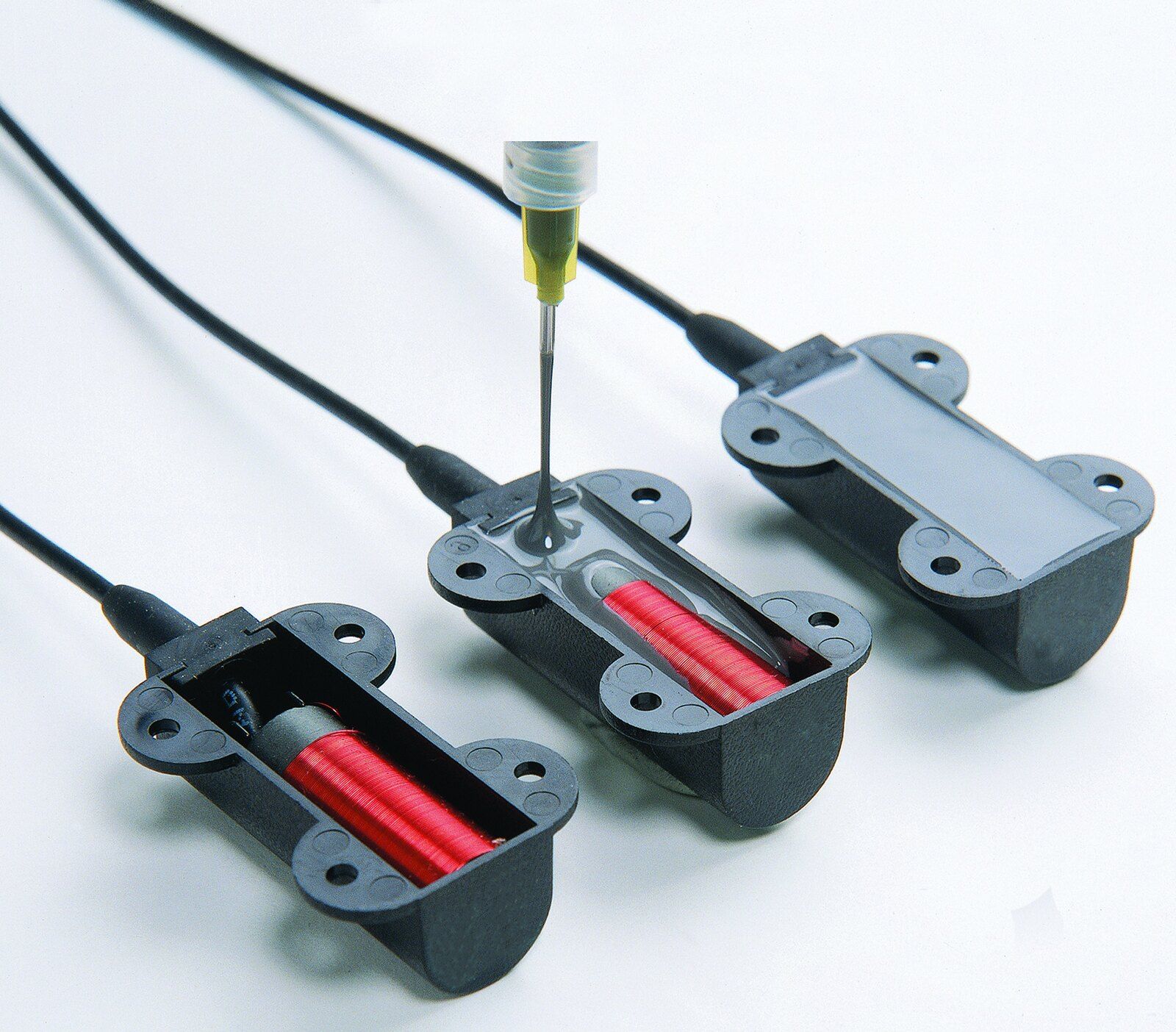
Coating or potting: when a film is not enough
A conformal coating puts a film on the board. Choose it when the main risk is humidity and the board must stay inspectable and repairable. Potting fills the volume around the board. Choose it when the assembly also needs heat transfer, vibration support or insulation in volume.
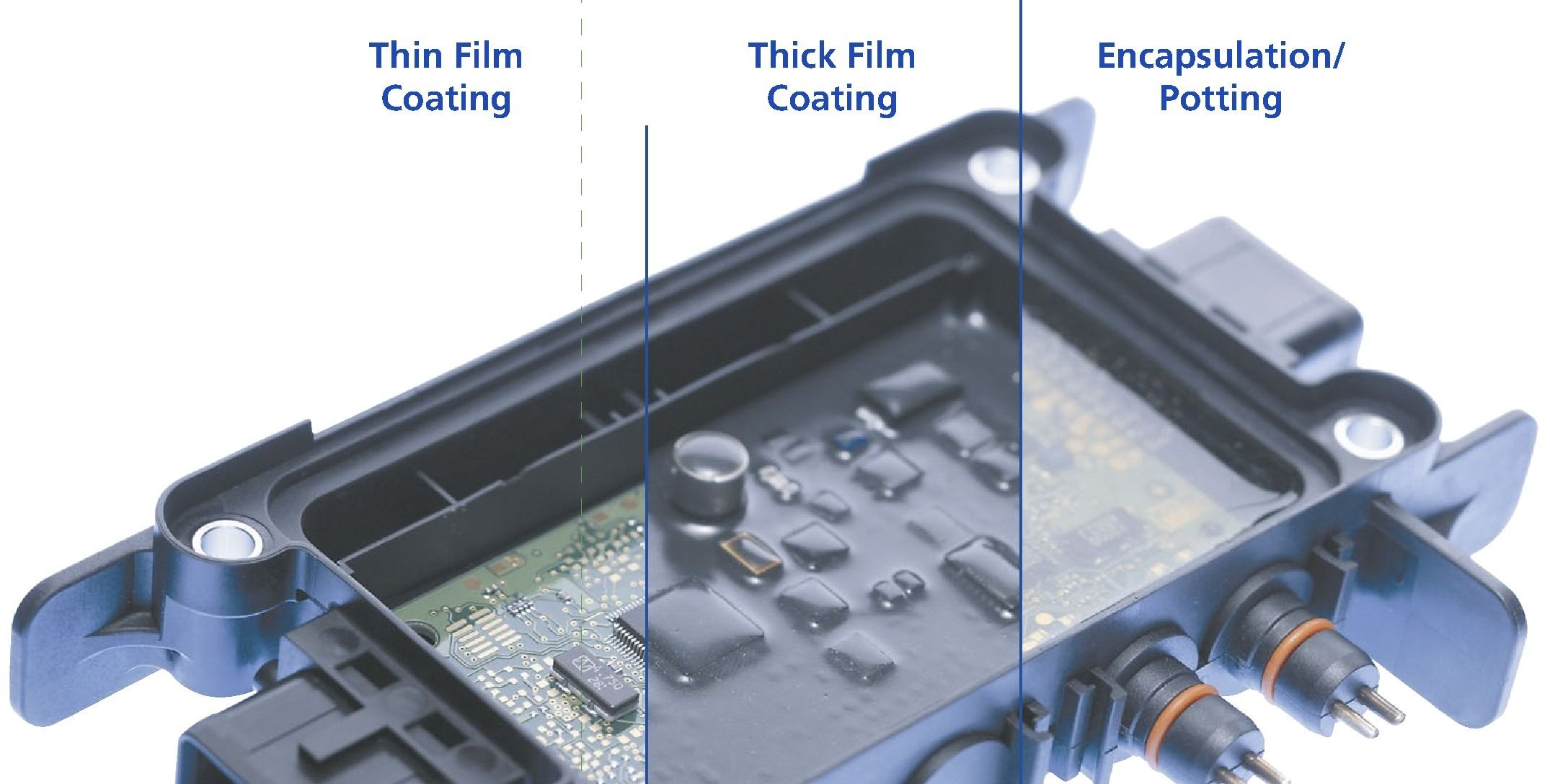
The datasheets show the difference in heat transfer. The thick-film coating PK 4340 lists 0.22–0.28 W/m·K. The potting compound PU 4526 lists 0.55–0.70 W/m·K, with a UL 94 V-0 listing at 5.5 mm (File E116643).
Conformal coating vs potting for power electronics: what the datasheets show · Conformal coating (for dam and fill, when only one area of the board needs encapsulating) · Thermal management
How it is applied: two components, one mix ratio, a pot life
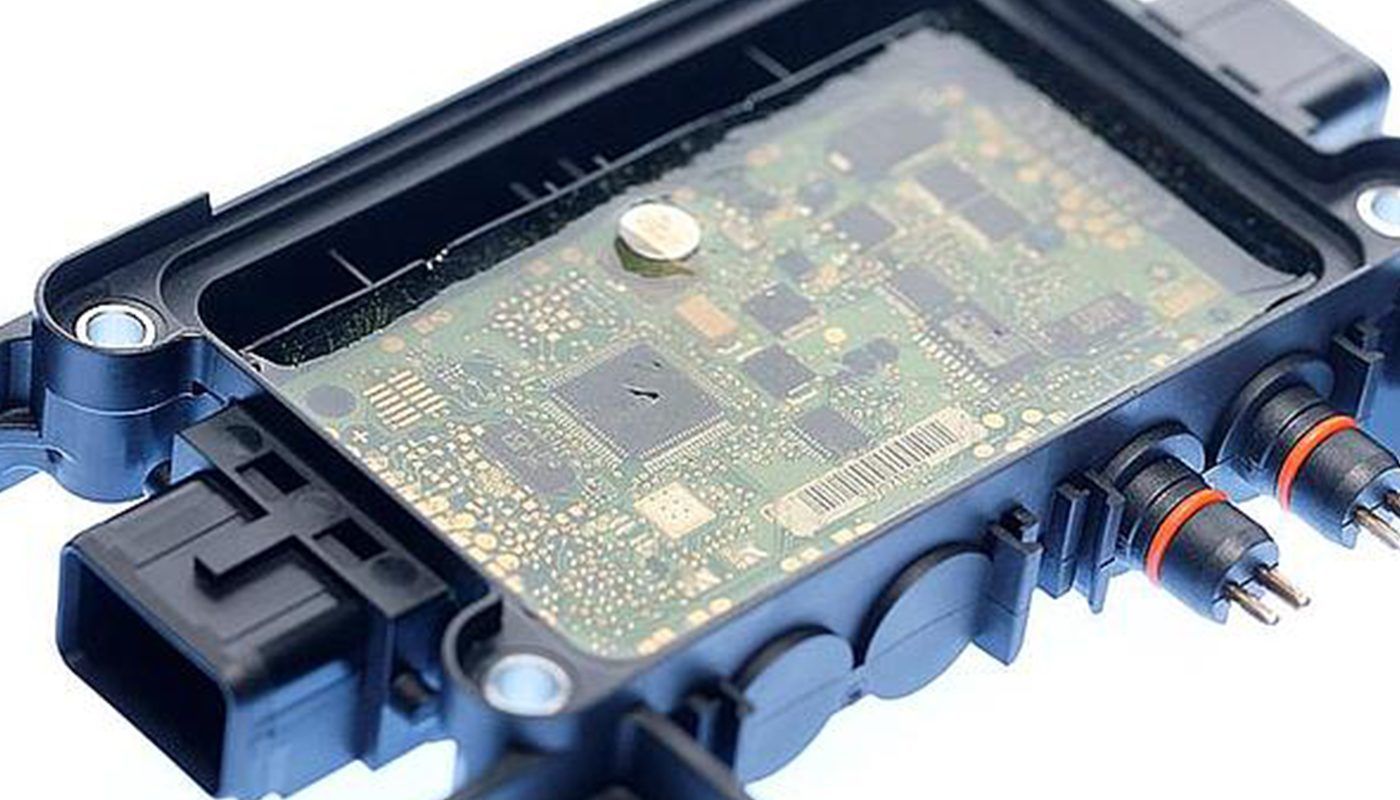
Most Bectron® potting compounds are two-component systems: a resin and a hardener, mixed at the ratio in the datasheet. From the moment they meet, the pot life runs. Warming the mix makes it flow more easily and shortens the time you can work with it. For PU 4526 the pot life is 12–22 min at 25 °C and 10–18 min at 40 °C.
PU 4526: viscosity against pot life
TDS values, at the two temperatures the TDS gives.

- Initial mixture viscosity
- 3,000–4,000 mPa·s
- Pot life (doubled initial viscosity)
- 12–22 min
- Gel time, 100 ml at 25 °C
- 40–60 min
- Initial mixture viscosity
- 1,600–2,000 mPa·s
- Pot life (doubled initial viscosity)
- 10–18 min
Source: ELANTAS TDS PU 4526 / PH 4912, N°2121 Rev. 4 (12/2024). The fill is schematic.
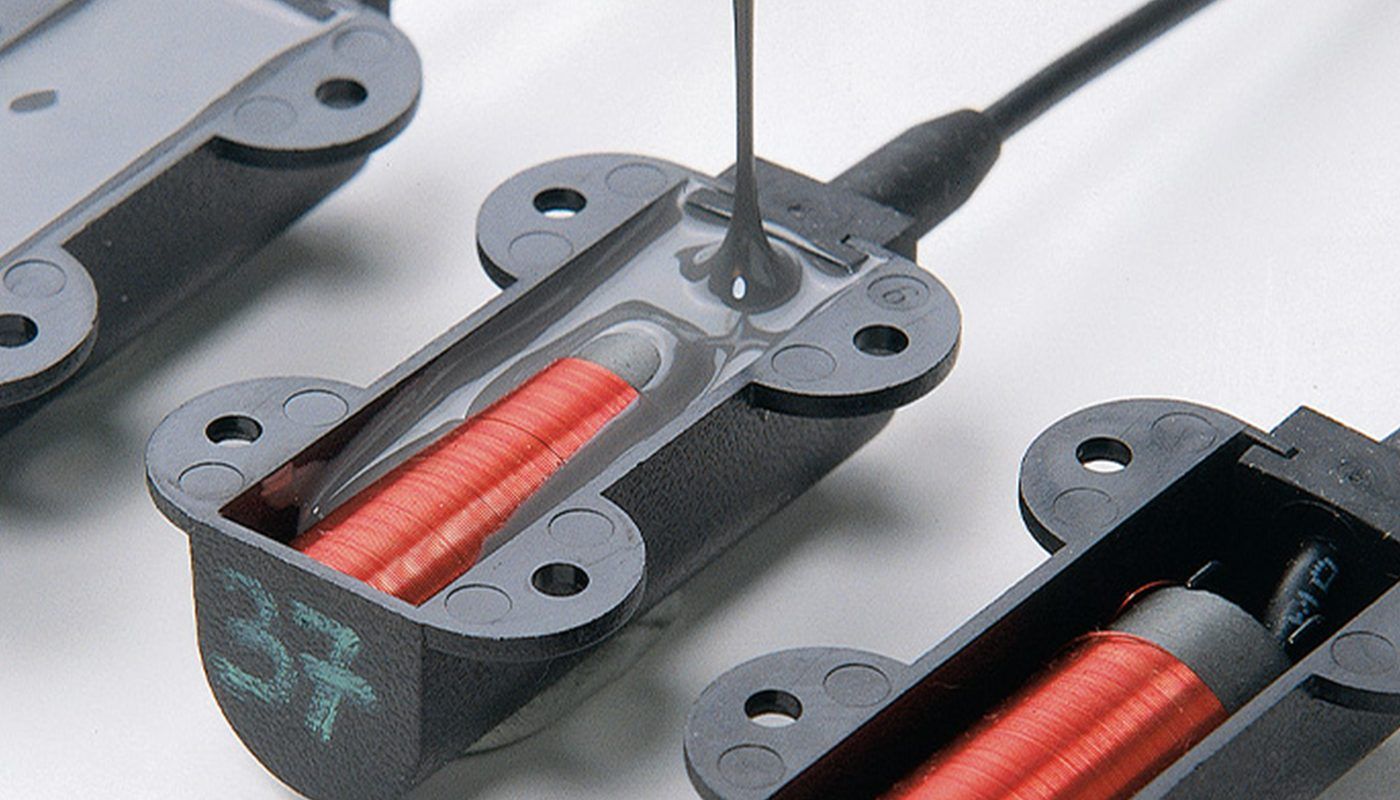
A pot life in minutes calls for metering equipment that mixes at the nozzle. ELANTAS writes that PU 4522 is “best processed by potting using two-component metering equipment but manual potting is possible”. We advise on the dispensing equipment around the material.
| 2-component polyurethane | PU 4501, PU 4522 | Meter-mix-dispense with static mixer, at the TDS mix ratio |
|---|---|---|
| 2-component silicone gel | SG 75V1-15, SG 75V1-60, SG 75V1-75 | Meter-mix-dispense; low viscosity flows into gaps |
| 2-component epoxy | EP 5502, EP 5504 | Meter-mix-dispense with static mixer |
| 1-component heat-curing polyurethane | PK 4344 | Volumetric 1-component dispensing, then oven cure |
| Dam | PT 4606 | High-viscosity volumetric bead around the area |
| Fill | PK 4342, PT 4600 | Lower-viscosity fill inside the dam |
How it cures: at room temperature, faster with heat
Most Bectron® potting compounds cure at room temperature, and for most of them heat shortens the cure. PU 4522 cures in 6 to 8 h at room temperature or in 30 min at 90 °C. The silicone SK 75V2-35 cures in 12 h at room temperature or in 30 min at 60 °C. The cure time decides how long a potted part waits before the next station. ELANTAS advises no mechanical or electrical load on a polyurethane cured at room temperature for 3 to 4 days.
| Chemistry | Example | At room temperature | With heat |
|---|---|---|---|
| Polyurethane | PU 4522 | 6 to 8 h | 30 min at 90 °C |
| Polybutadiene | PB 3201 | 48 h | 120 min at 60 °C, then some days to full cure |
| Silicone elastomer, addition cure | SK 75V2-35 | 12 h | 30 min at 60 °C |
| Silicone elastomer, condensation cure | SK 76V2-75 | about 6 h | – |
Silicone vs polyurethane potting: temperature, cure and moisture from the TDS
What goes wrong on the line, and what to check first
-
Bubbles and out-gassing in cured potting
- First cause
- The mix ratio is off: “Excess hardener may lead to bubbles in the cured resin and possible out-gassing after curing.”
- Check first
- The ratio the meter-mix machine actually delivers: weigh a shot of each component.
-
Hardener reacts slowly, or arrived crystallised
- First cause
- An opened PH 4912, PH 4901 or PH 4913 container has aged in air; moisture reduces the reactivity.
- Check first
- How the hardener tank on the machine is protected from air; the date the container was opened; the delivery temperature.
-
Silicone hardens inside the dispenser after weeks
- First cause
- Cross-contamination between the A and B paths.
- Check first
- The static mixer and valve flush routine; seals and dead zones in the valve.
-
Potting too viscous at room temperature
- First cause
- Viscosity depends on temperature; warming the mix lowers it and shortens the pot life.
- Check first
- Pail or drum temperature conditioning; whether the pump suits the viscosity.

Polyurethane or silicone: temperature and hardness
ELANTAS lists the two-component polyurethanes from 75 Shore A to 70 Shore D, with a maximum temperature (20,000 h) of +115 to +155 °C. The silicone elastomers are softer, 35 to 75 Shore A, with a maximum temperature (20,000 h) of 180 or 200 °C. Silicone gels are so soft that ELANTAS specifies them by penetration instead of Shore hardness. The guide to silicone vs polyurethane potting compares temperature, cure and moisture from the TDS.
Where to start
| If you need | Chemistry | Start with | From the datasheet |
|---|---|---|---|
| General potting with a UL 94 listing | Polyurethane | PU 4526 | UL 94 V-0 listed at 5.5 mm (File E116643); 35–45 Shore D; −30 to +130 °C |
| A soft, clear compound around sensitive parts | Polyurethane | PU 4501 | 35 ± 10 Shore A; flexible down to −50 °C; colourless |
| Flexibility at low temperature and under thermal shock | Polybutadiene | PB 3201 | glass transition at −63 °C |
| A service temperature up to 200 °C | Silicone elastomer | SK 75V2-45 | −55 to +200 °C; 1:1 mix |
| A silicone that does not suffer the cure inhibition addition-cure grades can | Silicone elastomer | SK 76V2-75 | condensation cure; −40 to +180 °C |
| The softest encapsulation | Silicone gel | SG 75L2-30 | pot life 120 min; −50 to +180 °C; UL 94 V-0 listed (File E 140720) |
| A clear, hard compound | Epoxy | EP 5502 | transparent two-component epoxy; pot life 30 min; +120 °C maximum operation temperature (ELANTAS brochure) |
Bectron® products and TDS values
The tables list the 39 Bectron® potting compounds with the values from the ELANTAS datasheets we have on file.
| Code | Chemical base | Mix ratio | Pot life | Hardness | Operating temperature |
|---|---|---|---|---|---|
| PU 4501 | Polyurethane (2-part, polyetherpolyol resin + aliphatic isocyanate hardener) | 100:50 (by weight) | 35 min | 35 ± 10 Shore A | Temperature cycling -40/+125 °C |
| PU 4512 | Polyurethane (2-component, filled) | – | 40 min | 70 Shore A | – |
| PU 4513 | Polyurethane (2-component, solvent-free) | 3.5 : 1 (by volume); 4.0 : 1 (by weight) | 50 min | 79 ± 9 Shore A | Thermal class 115 °C (IEC 216); flexible down to -40 °C |
| PU 4515 | Two-component polyurethane modified with polybutadiene, with Hardener Bectron PH 4912 | 5.0 : 1 by weight; 5.3 : 1 by volume (with PH 4912) | 14 min | 75 ± 5 Shore A | -60 to +150 °C |
| PU 4516 | Polyurethane (2-component) | – | 26 min | 70 ± 10 Shore D (ISO 868) | – |
| PU 4518 | – | – | – | – | – |
| PU 4519 | Polyurethane (2-component, solvent-free) | – | 50 min | – | – |
| PU 4520 | – | – | – | – | – |
| PU 4521 | – | – | – | – | – |
| PU 4522 | Polyurethane (2-component liquid) | 100 : 15 by weight = 5.4 : 1 by volume (20 °C), with PH 4912 | 15–20 min (25 °C) | 85 ± 5 Shore A | -40 °C to +125 °C |
| PU 4526 | Two-component polyurethane, with Hardener Bectron PH 4912 | 100 : 16.6 by weight; 100 : 21.5 by volume, with PH 4912 | 12–22 min (25 °C) | 35–45 Shore D/15 (25 °C, ASTM D 2240) | -30 to +130 °C |
| PU 4527 | Polyurethane (2-component) | – | 10 min | 40 ± 5 Shore D (ISO 868) | – |
| PU 4528 | Polyurethane (PU) | – | 25 min | 20 Shore A | – |
| PU 4532 | Polyurethane (PU) | – | 25 min | 50 Shore D | – |
| PU 4533 | Polyurethane (2-component, solvent-free) | 100 : 13 (by weight) | – | 35 ± 5 Shore A | -40 °C to +120 °C |
| PU 4534 | Polyurethane | 100 : 6 by weight; 12.76 : 1 by volume (with PH 4913) | – | 56 ± 10 Shore A | -40 °C to +130 °C |
| PU 4535 | Polyurethane (2-component) | 50:100 by weight (PU 4535 : PH 4901) | 28 ± 5 minutes (200g mixture at 23 °C) | 35 ± 10 Shore A | -40 °C to +120 °C |
| PU 4537 | Polyurethane (2-component) | 100 : 20 | 30 min | 64 Shore D | – |
| PU 4539 | Polyurethane (2-component, filled) | – | 40 min | 56 Shore A | – |
| Code | Chemical base | Mix ratio | Pot life | Hardness | Operating temperature |
|---|---|---|---|---|---|
| SK 75V1-35 | Silicone (2-component, addition cure) | 1:1 (parts by weight) | 180 minutes at room temperature | Shore A 35 | -40 °C to +200 °C |
| SK 75V2-35 | Silicone (2-component, addition cure) | 1:1 by weight | 75 minutes at room temperature | Shore A 35 | -50 °C to +180 °C |
| SK 75V2-45 | Two-component addition cure silicone, with crosslinker Bectron SH 79V2-45, Pt catalyst | 1:1 | 60 min | 45 Shore A | -55 to +200 °C |
| SK 75V2-65 | Silicone (2-component, addition cure) | 1:1 (parts by weight) | 60 minutes at room temperature | 50–80 Shore A, typical 65 (DIN 53505, 16 h at 80 °C) | -40 °C to +200 °C |
| SK 76V2-50 | Silicone (2-component) | – | 30 min | 50 Shore A | -40 to +180 °C |
| SK 76V2-75 | Silicone (2-component, condensation cure) | 100 parts SK 76V2-75 : 2.5 parts SH 79V5-75 (by weight) | 20 minutes at room temperature | Shore A 75 | -40 °C to +180 °C |
| SK 7502 | Silicone | 100 : 2 by weight (cross-linker SH 7931, condensation cure) | – | – | – |
| Code | Chemical base | Mix ratio | Pot life | Operating temperature |
|---|---|---|---|---|
| SG 75L2-30 | Silicone (2-component, addition cure) | – | 120 min | -50 °C to +180 °C |
| SG 75V1-15 | Silicone (2-component, addition cure) | 1:1 | 60 min | -45 °C to +200 °C |
| SG 75V1-60 | Silicone Gel (2-component) | – | 120 minutes at 25 °C | -45 to +200 °C |
| SG 75V1-70 | Silicone | – | 30 min | – |
| SG 75V1-75 | Silicone (2-component, addition cure) | 1:1 by weight | 45 minutes at room temperature | -40 °C to +180 °C |
| Code | Chemical base | Mix ratio | Pot life | Hardness | Operating temperature |
|---|---|---|---|---|---|
| EP 5502 | Epoxy | – | 30 min | – | Max. operation temperature +120 °C (no lower limit printed) |
| EP 5503 | Epoxy resin | 100:18-20 (by weight) | – | Shore D 85 | -40 °C to +150 °C |
| EP 5504 | Epoxy resin | – | – | Shore D 82 | Max. temperature 155 °C / 20,000 h |
| Code | Chemical base | Mix ratio | Pot life | Hardness | Operating temperature |
|---|---|---|---|---|---|
| PB 3200 | Polybutadiene | 100:18 (by weight) | – | Shore A 30 ± 10 | – |
| PB 3201 | Polybutadiene | 100:58 by weight (PB 3201 : PH 4918) | 25 min | Shore A 70 ± 10 | -60 °C to +150 °C |
| PB 3251 | Polybutadiene | 100:33 (by weight) | 20 min | 80 ± 10 Shore A | -60 to +150 °C |
| PB 3252 | Polybutadiene | 3:1 (by weight) | 25 min | Shore A 65 ± 10 | -55 to +120 °C |
| PB 4540 | Polybutadiene | – | 8 min | 43 A | – |
Polyurethane · 19
- PU 4501Polyurethane (2-part, polyetherpolyol resin + aliphatic isocyanate hardener)
- PU 4512Polyurethane (2-component, filled)
- PU 4513Polyurethane (2-component, solvent-free)
- PU 4515Two-component polyurethane modified with polybutadiene, with Hardener Bectron PH 4912
- PU 4516Polyurethane (2-component)
- PU 4518
- PU 4519Polyurethane (2-component, solvent-free)
- PU 4520
- PU 4521
- PU 4522Polyurethane (2-component liquid)
- PU 4526Two-component polyurethane, with Hardener Bectron PH 4912
- PU 4527Polyurethane (2-component)
- PU 4528Polyurethane (PU)
- PU 4532Polyurethane (PU)
- PU 4533Polyurethane (2-component, solvent-free)
- PU 4534Polyurethane
- PU 4535Polyurethane (2-component)
- PU 4537Polyurethane (2-component)
- PU 4539Polyurethane (2-component, filled)
Silicone elastomer · 7
- SK 75V1-35Silicone (2-component, addition cure)
- SK 75V2-35Silicone (2-component, addition cure)
- SK 75V2-45Two-component addition cure silicone, with crosslinker Bectron SH 79V2-45, Pt catalyst
- SK 75V2-65Silicone (2-component, addition cure)
- SK 76V2-50Silicone (2-component)
- SK 76V2-75Silicone (2-component, condensation cure)
- SK 7502Silicone
Silicone gel · 5
Polybutadiene · 5
Manufactured by ELANTAS Europe; ELANTAS Europe’s plants are certified to IATF 16949:2016 (ELANTAS presentation, 07/2024).
What we do on a potting project
We help you choose the compound that fits your part’s requirements and the mixing and cure your line can run. We help with samples and trial quantities for your line, and send the current TDS and SDS from ELANTAS. Lead time for Bectron®: 8 weeks from order. Bectron® deliveries come with a certificate of analysis from ELANTAS.
Next to this: Conformal coating · Thermal management
Ask for a sample, a TDS, a quote or a dose calculation
Tell us what you need. We reply within 24 hours, in Romanian or English.
Contact directly
Alexandru Nichifor
Sales & technical support
nichiforlx@
Naltek Solutions S.R.L.
Sat Comori, Com. Gurghiu, nr. 81, jud. Mureș 547298