How to calculate UV dose on a conveyor: mW/cm², mJ/cm² and belt speed
18 October 2026 · Checked against the ELANTAS Bectron PT 4600 TDS N°1875 Rev. 2, 02/2024 (p. 2 curing and conveyor speed; p. 3 UV-curing row), the PT 4601 TDS dated 07/02/2012 (pp. 2–3, newest on file) and Hoenle product data according to hoenle.com on 2026-11-12
UV dose is irradiance multiplied by exposure time: mJ/cm² = mW/cm² × s. On a conveyor, exposure time is the lit length divided by belt speed. Bectron® PT 4600 needs 2,500–3,500 mJ/cm² UVA at 1–2.5 m/min (ELANTAS TDS, 02/2024). At 3,000 mJ/cm², a 100 mm lit zone needs about 500–1,250 mW/cm² average irradiance at the board.
Short answer: the formula
| Quantity | Symbol | Unit | Relation |
|---|---|---|---|
| Dose | D | mJ/cm² | D = E × t |
| Irradiance (average over the lit zone) | E | mW/cm² | E = D ÷ t |
| Exposure time | t | s | t = 0.06 × L ÷ v |
| Lit length along the belt | L | mm | Length of the zone where UV reaches the board |
| Belt speed | v | m/min | 1 m/min = 16.7 mm/s |
The factor 0.06 converts units: v in m/min × 1000 ÷ 60 gives mm/s, and L in mm divided by that speed gives seconds.
Irradiance and dose: what each unit means
Irradiance (mW/cm²) is the UV power arriving on each square centimetre of the board at a given moment. Dose (mJ/cm²) is the energy collected over the exposure, because 1 mW for 1 s is 1 mJ. A coating TDS specifies dose: the PT 4600 TDS gives “UV-curing 2500 - 3500 mJ / cm² (UVA)” and “3 ÷ 7 s” (TDS 02/2024, p. 3). A lamp catalogue specifies irradiance. The formula connects the two.
A radiometer that rides on the belt through the tunnel records irradiance over time; its dose reading is the integral of that curve, and that is the value to compare with the TDS.
Exposure time on a belt: lit length ÷ belt speed
| Belt speed | Speed in mm/s | Time under 100 mm lit length |
|---|---|---|
| 1.0 m/min | 16.7 mm/s | 6.0 s |
| 1.5 m/min | 25.0 mm/s | 4.0 s |
| 2.0 m/min | 33.3 mm/s | 3.0 s |
| 2.5 m/min | 41.7 mm/s | 2.4 s |
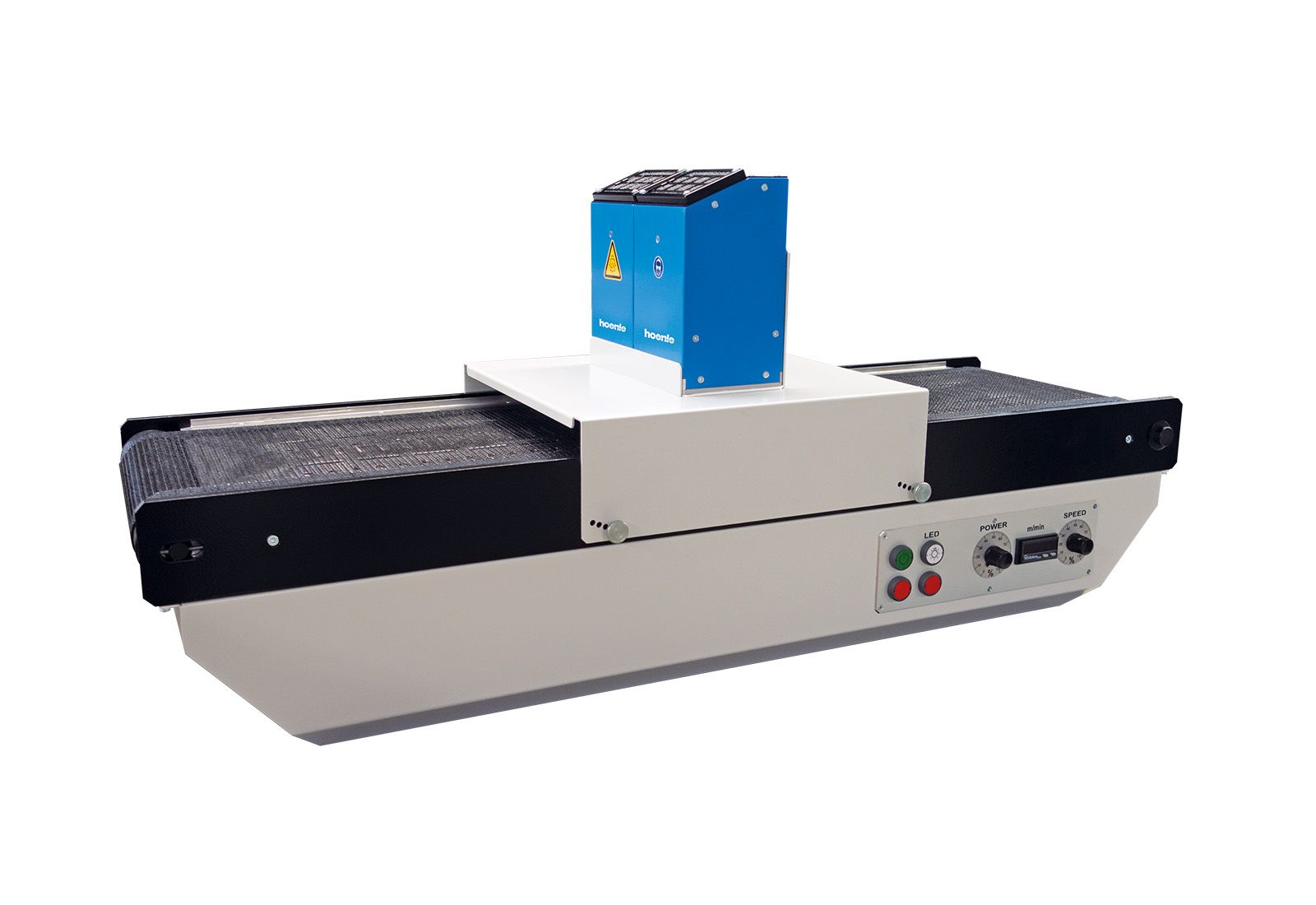
The 100 mm lit length is the emission window of the Hoenle LED Spot 100 IC, about 100 × 100 mm according to hoenle.com. At the board, the lit length depends on working distance, because the light spreads as it travels; it is longer than the window and the irradiance at its edges is lower.
Worked example: PT 4600 at 3000 mJ/cm² inside 1–2.5 m/min
PT 4600 needs 2,500–3,500 mJ/cm² UVA (TDS 02/2024) and PT 4601 3000 ± 500 mJ/cm² (TDS 07/02/2012); both TDSs set the conveyor speed at 1–2.5 m/min. The PT 4600 TDS refers the dose to a usual film thickness of 200 ± 50 µm; the PT 4601 TDS refers it to 300 ± 50 µm.
| Belt speed | Time under 100 mm | Average irradiance for 2500 mJ/cm² | Average irradiance for 3000 mJ/cm² | Average irradiance for 3500 mJ/cm² |
|---|---|---|---|---|
| 1.0 m/min | 6.0 s | 417 mW/cm² | 500 mW/cm² | 583 mW/cm² |
| 1.5 m/min | 4.0 s | 625 mW/cm² | 750 mW/cm² | 875 mW/cm² |
| 2.0 m/min | 3.0 s | 833 mW/cm² | 1000 mW/cm² | 1167 mW/cm² |
| 2.5 m/min | 2.4 s | 1042 mW/cm² | 1250 mW/cm² | 1458 mW/cm² |
Cross-check with the TDS: 3000 mJ/cm² in approx. 5 s (PT 4600 TDS 02/2024, p. 2) means about 600 mW/cm² average. Under a 100 mm lit length, 5 s corresponds to a belt speed of 1.2 m/min, inside the TDS window.
These figures are the average irradiance the board must receive. They do not say what a given lamp delivers at your working distance.
Why the conveyor speed has a lower limit too
The PT 4600 TDS states: “The conveyor speed should be 1-2.5 m/min to limit influence of heat” (TDS 02/2024, p. 2). The PT 4601 TDS uses the same wording. Running slower than 1 m/min to reach the dose leaves this window; inside it, more dose comes from higher irradiance at the board or from an additional lamp. The Hoenle Convey LED belt runs at 0.1–20.0 m/min, according to hoenle.com, so the belt itself covers the TDS window.
| Hoenle Convey LED (according to hoenle.com) | Value |
|---|---|
| Belt speed | 0.1–20.0 m/min |
| Belt width | 110–520 mm |
| LED wavelengths | 365, 385, 395, 405, 460 nm |
| Other sources | Broad-spectrum UV 320–460 nm, conventional lamps possible |
Catalogue irradiance vs irradiance at your board
Hoenle states irradiance per wavelength. Some values carry a distance, others do not, and the irradiance at your board depends on the distance between emitter and board.
| Hoenle unit (according to hoenle.com) | Irradiance | Distance stated | Emission window |
|---|---|---|---|
| LED Spot 100 IC | 1100 / 1500 / 1700 / 2000 / 2500 mW/cm² at 365 / 385 / 395 / 405 / 460 nm | 0 mm (Hoenle UV Meter, LED surface sensor) | About 100 × 100 mm |
| LED Spot 100 HP IC | 2200 / 3000 / 3500 / 4000 / 5000 mW/cm² at 365 / 385 / 395 / 405 / 460 nm | 0 mm (Hoenle UV Meter, LED surface sensor) | About 100 × 100 mm |
| LED Line 500 | 130 mW/cm² at 365 nm; 300 mW/cm² at 405 nm | 20 mm | About 500 × 15 mm |
| LED Powerline LC | 14,000 / 20,000 / 25,000 / 25,000 mW/cm² at 365 / 385 / 395 / 405 nm, typical | Not stated | About 76 × 10 or 114 × 10 mm |
LED Spot 100 IC1100 / 1500 / 1700 / 2000 / 2500 mW/cm² at 365 / 385 / 395 / 405 / 460 nm
- Distance stated
- 0 mm (Hoenle UV Meter, LED surface sensor)
- Emission window
- About 100 × 100 mm
LED Spot 100 HP IC2200 / 3000 / 3500 / 4000 / 5000 mW/cm² at 365 / 385 / 395 / 405 / 460 nm
- Distance stated
- 0 mm (Hoenle UV Meter, LED surface sensor)
- Emission window
- About 100 × 100 mm
LED Line 500130 mW/cm² at 365 nm; 300 mW/cm² at 405 nm
- Distance stated
- 20 mm
- Emission window
- About 500 × 15 mm
LED Powerline LC14,000 / 20,000 / 25,000 / 25,000 mW/cm² at 365 / 385 / 395 / 405 nm, typical
- Distance stated
- Not stated
- Emission window
- About 76 × 10 or 114 × 10 mm
We use a catalogue figure in the formula only as an upper bound. The irradiance profile under a lamp is also not flat: it peaks under the emitter and falls toward the edges of the lit zone, so the peak value is higher than the average the formula needs. The worked example above uses the average.
Multiple lamps and multiple passes: doses add
Each lamp contributes its own irradiance × time, and the doses add. Two lamps that each deliver 1500 mJ/cm² to the board at a given belt speed give 3000 mJ/cm² in one pass. Two passes under one lamp add the same way, with the PT 4600 TDS heat limit on belt speed applying to each pass.
How Naltek works out your dose
We calculate the dose for your line from lamp type, lens, working distance and belt speed (dose = irradiance × time), and compare it with the dose in your coating’s TDS. If you want a measured value as well, we measure it on site during a visit. Hoenle LED area, line and conveyor units are on our Hoenle page; the coatings are on the PT 4600 and PT 4601 pages.
| What to send | Why we need it |
|---|---|
| Coating code | Gives the target dose and speed window from its TDS |
| Film thickness | The TDS dose refers to a stated thickness (200 ± 50 µm for PT 4600) |
| Belt speed | Sets the exposure time |
| Lamp model and lens | Sets irradiance and lit length |
| Working distance | Irradiance and lit length change with distance |
| Radiometer reading, if you have one | A measured value to compare with the calculation |
Send these through the inquiry form and ask for a dose calculation, or run the numbers yourself in the UV dose calculator.
Questions engineers ask
How do I convert mW/cm² to mJ/cm²?
Multiply the irradiance in mW/cm² by the exposure time in seconds: 1 mW/cm² for 1 s gives 1 mJ/cm². For example, 600 mW/cm² for 5 s gives 3000 mJ/cm², the dose at which the Bectron PT 4600 TDS gives about 5 s for a 200 ± 50 µm film (window 2,500–3,500 mJ/cm²).
Does a slower belt always help?
A slower belt raises the dose, but the PT 4600 and PT 4601 TDSs set the conveyor speed at 1–2.5 m/min to limit the influence of heat. Below 1 m/min you leave the TDS window.
Can I use the catalogue irradiance in the formula?
Only as an upper bound. Catalogue irradiance applies at the measuring condition the manufacturer states; where no distance is stated (e.g. LED Powerline LC), treat it as an upper bound. Naltek calculates the irradiance at your working distance from lamp type and lens, or measures it on site during a visit if you want.
Do two lamps in a row add dose?
Yes. Each lamp delivers its own irradiance × time, and the doses add. The same holds for several passes under one lamp.
Which wavelength should the lamp have for PT 4600?
The PT 4600 TDS says only UVA and gives no wavelength. We confirm wavelength suitability with ELANTAS case by case before matching a 365, 385, 395 or 405 nm LED head to the coating.
Application page: UV curing