Hot-melt (melting resin) PCB coating: what application temperature?
18 October 2026 · Checked against the ELANTAS TDSs for MR 3406 (16/12/2009, p. 2–3), MR 3406 FR (preliminary TDS N°1926 Rev. 2, 03/2024, p. 2–3) and MR 3404 (29/04/2013, p. 2–3); MR 3406 FR re-checked on 2026-11-08
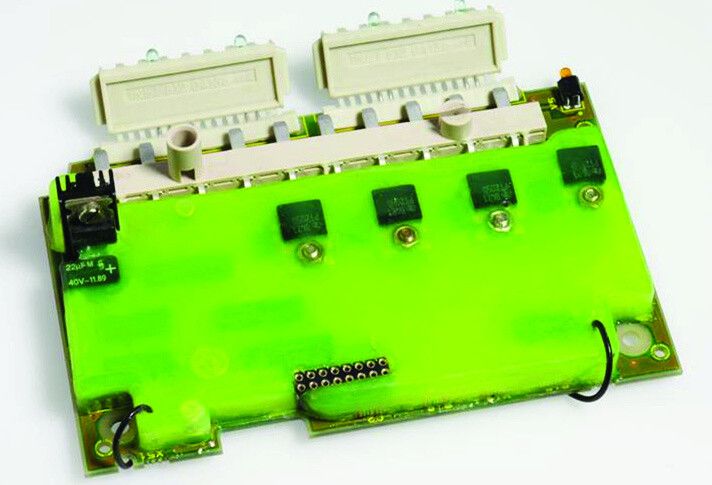
Bectron® MR 3406 polyolefin hot melt should reach 190–200 °C at the nozzle, according to the ELANTAS TDS dated 16/12/2009. It starts to soften at +140 °C, its viscosity is specified at 180 °C, material in the reservoir should be held at 170 °C for 1 day maximum, and it is normally hard below +100 °C.
The temperatures in the MR 3406 TDS
| Temperature | What the TDS says | Source |
|---|---|---|
| 190–200 °C | “During application the temperature should reach 190-200°C at the nozzle.” | TDS 16/12/2009, p. 2 |
| 180 °C | Viscosity measurement: 520 ± 200 mPa·s (DIN 53018) | TDS 16/12/2009, p. 3, Table 1 |
| 170 °C | “Material in an equipment reservoir should be held at 170°C for 1 day maximum.” | TDS 16/12/2009, p. 2 |
| +140 °C | “starts to soften”; melting point 140 °C | TDS 16/12/2009, p. 2; p. 3, Table 2 |
| below +100 °C | “normally hard below +100°C, but complete solidification may be slow” | TDS 16/12/2009, p. 2 |
| up to 90 °C | Substrate preheat that “may be needed for thin layers to be uniform and free of defects” | TDS 16/12/2009, p. 2 |
| −40 to +120 °C | Operating range of the solidified resin; maximum operating temperature 120 °C | TDS 16/12/2009, p. 2; p. 3, Table 2 |
Why 180 °C is not the application temperature
180 °C appears in the TDS only as the condition for the viscosity value in Table 1. The application instruction on page 2 is 190–200 °C at the nozzle, with the reservoir at 170 °C. A nozzle set to 180 °C is therefore below the TDS window. The MR 3404 TDS (29/04/2013) and the MR 3406 FR TDS (26/03/2019) give the same nozzle window and the same reservoir limit, while also quoting their viscosity at 180 °C.
| Product | Nozzle, °C | Reservoir | Viscosity (method) | Softening / melting | Maximum operating | Hardness (ISO 868, 23 °C), Shore A | Source |
|---|---|---|---|---|---|---|---|
| MR 3406 | 190–200 °C | 170 °C, 1 day max | 520 ± 200 mPa·s at 180 °C (DIN 53018) | softens at +140 °C; melting point 140 °C | 120 °C (−40 to +120 °C) | 14 ± 4 Shore A | TDS 16/12/2009, p. 2–3 |
| MR 3406 FR | 190–200 °C | 170 °C, 1 day max, under stirring | 800–1,250 mPa·s at 180 °C (PP 25, DIN 53019) | not stated | 125 °C (168 h); range −40 to +125 °C | 15–25 Shore A | preliminary TDS 03/2024, p. 2–3 |
| MR 3404 | 190–200 °C | 170 °C, 1 day max | 1,100 ± 400 mPa·s at 180 °C (DIN 53018) | melting range 110–150 °C (DSC, 20 K/min) | 105 °C (−40 to +105 °C) | 20 ± 6 Shore A | TDS 29/04/2013, p. 2–3 |
Bubbles: a wet substrate, and thin layers
| Symptom | TDS instruction | Source |
|---|---|---|
| Bubbles in the coating | “The substrate should be dry in order to avoid bubbles of moisture.” | MR 3406 TDS, p. 2 |
| Uneven or defective thin layer | “special coating equipment e.g. spray nozzle, is necessary”; “Preheating of the substrate up to 90°C may be needed for thin layers to be uniform and free of defects.” | MR 3406 TDS, p. 2 |
| Slow final hardening | “normally hard below +100°C, but complete solidification may be slow” | MR 3406 TDS, p. 2 |
The TDS names “commercially available hot melt guns or heated dispensers” as application equipment; the MR 3406 FR TDS specifies heated dispensers “containing a stirrer”. Application notes are on our dispensing page; Naltek supplies the material, not the equipment.
Adhesion: flux, dryness, solder resist
The MR 3406, MR 3406 FR and MR 3404 TDSs list the same three checks “to ensure satisfactory adhesion on the PCB surface”:
| Check | TDS wording | Source |
|---|---|---|
| Flux | “Use of residue-free flux” | MR 3406 TDS, p. 2 |
| Surface | “ensure dry surfaces” | MR 3406 TDS, p. 2 |
| Board materials | “Check compatibility of the coating resin with the solder resist and solder paste.” | MR 3406 TDS, p. 2 |
MR 3406 vs MR 3406 FR
| Property | MR 3406 | MR 3406 FR | Source |
|---|---|---|---|
| Maximum operating temperature | 120 °C | 125 °C (168 h; preliminary) | MR 3406 TDS p. 2; MR 3406 FR preliminary TDS 03/2024 p. 2–3 |
| UL 94 | no UL statement | V-0, min. thickness 3.0–3.3 mm, File No. E140720 | MR 3406 FR preliminary TDS 03/2024 p. 3 |
| Composition note | polyolefin | halogen-, phosphate- and silicone-free | MR 3406 FR TDS p. 2 |
| Reservoir | 170 °C, 1 day max | 170 °C, 1 day max, under stirring | both TDSs, p. 2 |
| Hardness (ISO 868, 23 °C) | 14 ± 4 Shore A | 15–25 Shore A | both TDSs, p. 3 |
| Shelf life | minimum 6 months, cool and dry, bricks kept separated | 12 months at 5–35 °C, cool and dry, bricks kept separated | both TDSs, p. 2 |
MR 3406 FR states UL 94 V-0 (3.0–3.3 mm) and a maximum operating temperature of 125 °C; MR 3406 states 120 °C and no UL rating. The MR 3406 FR values come from a preliminary TDS (03/2024) and may still change, so ask us for the current TDS before you write it into a specification.
Polyolefin vs polyamide, and rework by remelting
The MR 3406 TDS describes its polyolefin chemistry as “better suited to electronics than conventional polyamide based hot-melt thermoplastic”. The TDS gives no figures for a polyamide product, so that comparison is ELANTAS’s statement, not a measured result. What the TDS does give for MR 3406:
| Property | Value | Source |
|---|---|---|
| Volume resistivity | 3 × 10¹⁵ Ω·cm initial; 5 × 10¹⁵ Ω·cm after 7 days of water immersion | TDS 16/12/2009, p. 3, Table 4 |
| Dielectric strength | >30 kV/mm (VDE 0303 Part 2) | TDS 16/12/2009, p. 3, Table 4 |
| Water absorption | 0.05 % (ISO 62 Method 1, 24 h, 23 °C) | TDS 16/12/2009, p. 3, Table 5 |
| Chemical resistance | resistant to acids, bleach, polar solvents and fungal growth; not resistant to aliphatic, aromatic and chlorinated solvents | TDS 16/12/2009, p. 2 |
| Rework | “Very easy re-work as it can be melted and hardened reversibly” | TDS 16/12/2009, p. 2 |
| Cure | no curing reaction, “only a rapid solidification of the resin on cooling”; no curing oven | TDS 16/12/2009, p. 2 |
What the TDS does not cover: low-pressure moulding
None of the three TDSs gives a mould temperature, injection pressure or cycle time for moulding in a closed tool. They give the nozzle and reservoir temperatures above; mould parameters have to be set by trial on your part.
Through the inquiry form, send us your board, the area to coat and your current nozzle and reservoir settings. We reply with the matching MR TDS and a sample proposal.
Questions engineers ask
What temperature should the hot-melt nozzle be for MR 3406?
190–200 °C. The MR 3406 TDS (16/12/2009, p. 2) states: 'During application the temperature should reach 190-200°C at the nozzle.'
How long can MR 3406 stay hot in the tank?
The TDS says material in an equipment reservoir should be held at 170 °C for 1 day maximum. The MR 3406 FR TDS adds that the reservoir should be stirred.
Is 180 °C the application temperature?
No. 180 °C is the temperature at which the TDS measures viscosity (520 ± 200 mPa·s, DIN 53018). The nozzle temperature in the same TDS is 190–200 °C.
Why do I get bubbles in the hot-melt coating?
The MR 3406 TDS states the substrate should be dry to avoid bubbles of moisture. For thin layers it adds that preheating the substrate up to 90 °C may be needed for a uniform, defect-free film.
Can a hot-melt coated board be reworked?
Yes. The MR 3406 TDS describes 'very easy re-work as it can be melted and hardened reversibly'.
Is MR 3406 flame retardant?
The MR 3406 TDS gives no UL rating. MR 3406 FR is UL 94 V-0 at a minimum thickness of 3.0–3.3 mm, File No. E140720, according to its preliminary TDS (Rev. 2, 03/2024).
Application page: Melting resins (hot melt)