Silicone vs polyurethane potting: temperature, cure and moisture from the TDS
18 October 2026 · Checked against the ELANTAS TDSs for SK 75V2-45 and SK 75V2-65 (26/04/2017, p. 2–3), PU 4515 (29/08/2016, p. 2–4), PU 4526 (TDS N°2121 Rev. 4, 12/2024, p. 2–4) and PU 4527 (27/05/2008, p. 2–3) on 2026-11-12
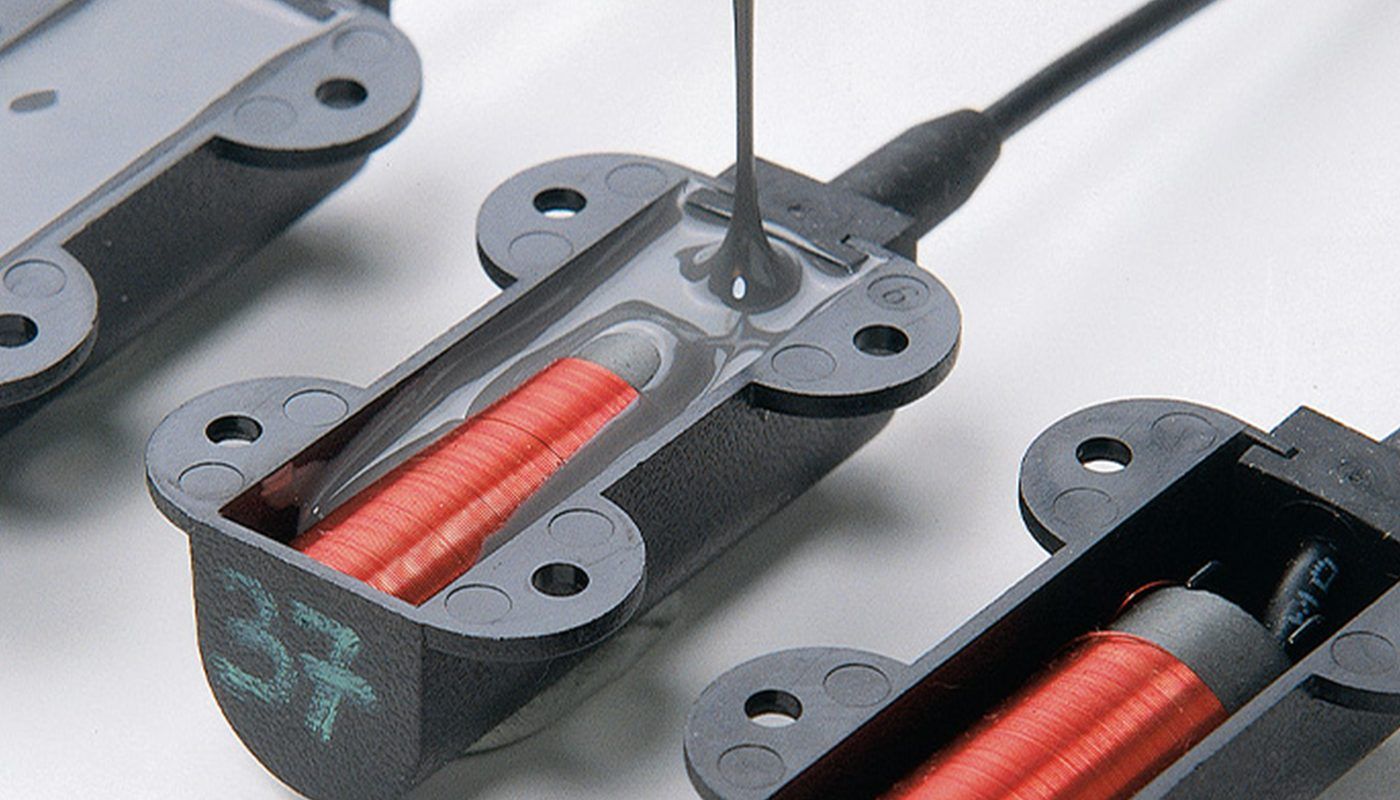
Choose silicone potting when the unit must work above +150 °C, up to +200 °C; choose polyurethane for a harder compound. In the ELANTAS TDSs compared here, the polyurethane also kept more of its insulation after water immersion. Bectron® SK 75V2-45 covers −55 to +200 °C; PU 4515 covers −60 to +150 °C, and PU 4526 −40 to +130 °C.
Temperature range: four TDSs
| Product | Chemistry (TDS) | Temperature range | Other thermal data | Source |
|---|---|---|---|---|
| SK 75V2-45 + SH 79V2-45 | 2K addition-cure silicone, platinum catalyst | −55 to +200 °C | 0.54 W/m·K | TDS 26/04/2017, p. 2–3 |
| SK 75V2-65 + SH 79V2-65 | 2K addition-cure silicone, platinum catalyst | −40 to +200 °C | 0.45 W/m·K | TDS 26/04/2017, p. 2–3 |
| PU 4515 + PH 4912 | 2K polyurethane modified with polybutadiene | −60 to +150 °C | Thermal index 150 °C (IEC 216); Tg < −75 °C (IEC 61006); 0.2 W/m·K (DIN 52613) | TDS 29/08/2016, p. 2–3 |
| PU 4526 + PH 4912 | 2K polyurethane, medium hard | −30 to +130 °C (thermal class B) | Tg 5–15 °C (ASTM D 3418); 0.55–0.70 W/m·K (ASTM C 518) | TDS 12/2024, p. 2–4 |
SK 75V2-45 + SH 79V2-452K addition-cure silicone, platinum catalyst
- Product
- SK 75V2-45 + SH 79V2-45
- Temperature range
- −55 to +200 °C
- Other thermal data
- 0.54 W/m·K
- Source
- TDS 26/04/2017, p. 2–3
SK 75V2-65 + SH 79V2-652K addition-cure silicone, platinum catalyst
- Product
- SK 75V2-65 + SH 79V2-65
- Temperature range
- −40 to +200 °C
- Other thermal data
- 0.45 W/m·K
- Source
- TDS 26/04/2017, p. 2–3
PU 4515 + PH 49122K polyurethane modified with polybutadiene
- Product
- PU 4515 + PH 4912
- Temperature range
- −60 to +150 °C
- Other thermal data
- Thermal index 150 °C (IEC 216); Tg < −75 °C (IEC 61006); 0.2 W/m·K (DIN 52613)
- Source
- TDS 29/08/2016, p. 2–3
PU 4526 + PH 49122K polyurethane, medium hard
- Product
- PU 4526 + PH 4912
- Temperature range
- −30 to +130 °C (thermal class B)
- Other thermal data
- Tg 5–15 °C (ASTM D 3418); 0.55–0.70 W/m·K (ASTM C 518)
- Source
- TDS 12/2024, p. 2–4
PU 4515 reaches lower than either silicone (−60 °C against −55 °C and −40 °C); the silicones reach higher (+200 °C against +150 °C).
Hardness and mechanical protection
| Product | Hardness | Method / condition | Elongation at break | Source |
|---|---|---|---|---|
| SK 75V2-45 | 45 Shore A | typical value, cured | not stated | TDS 26/04/2017, p. 3 |
| SK 75V2-65 | 65 Shore A typical; specification 50–80 Shore A | DIN 53505, after 16 h at 80 °C | not stated | TDS 26/04/2017, p. 3 |
| PU 4515 | 75 ± 5 Shore A | ISO 868, 23 °C | 71 % (DIN EN ISO 527-1) | TDS 29/08/2016, p. 3, Table 4 |
| PU 4526 | 35–45 Shore D/15 | ASTM D 2240, 25 °C | 50–70 % (ASTM D 638) | TDS 12/2024, p. 4 |
SK 75V2-4545 Shore A
- Method / condition
- typical value, cured
- Elongation at break
- not stated
- Source
- TDS 26/04/2017, p. 3
SK 75V2-6565 Shore A typical; specification 50–80 Shore A
- Method / condition
- DIN 53505, after 16 h at 80 °C
- Elongation at break
- not stated
- Source
- TDS 26/04/2017, p. 3
PU 451575 ± 5 Shore A
- Method / condition
- ISO 868, 23 °C
- Elongation at break
- 71 % (DIN EN ISO 527-1)
- Source
- TDS 29/08/2016, p. 3, Table 4
PU 452635–45 Shore D/15
- Method / condition
- ASTM D 2240, 25 °C
- Elongation at break
- 50–70 % (ASTM D 638)
- Source
- TDS 12/2024, p. 4
The PU 4526 TDS names “electronics subject to shock and vibration (e.g. impact drills and automotive electronics)” and sensors as applications. The SK 75V2-45 TDS names encapsulation of “very sensitive electronic circuits and components operating in very high temperatures”.
Insulation after water immersion
| Product | Volume resistivity, dry | After 7 days in water | Dielectric strength | Immersion condition as printed | Source |
|---|---|---|---|---|---|
| SK 75V2-45 | 9.0 × 10¹⁴ Ω·cm | 2.2 × 10¹¹ Ω·cm | 8.0 kV/mm (dry) | “after 7 days of water immersion”, temperature not stated | TDS 26/04/2017, p. 3 |
| PU 4515 | 2.2 × 10¹⁴ Ω·cm (IEC 60455-2, 23 °C) | 1.6 × 10¹⁴ Ω·cm | 33 kV/mm dry; 22.3 kV/mm after 7 days in water (IEC 60250, as listed) | “53°, 7 days in water” | TDS 29/08/2016, p. 4, Table 5 |
| PU 4526 | 10¹³–10¹⁴ Ω·cm (25 °C, ASTM D 257) | not stated | 22–26 kV/mm (25 °C, 2 mm, ASTM D 149) | — | TDS 12/2024, p. 4 |
From these values, SK 75V2-45 lost about three and a half orders of magnitude of volume resistivity after immersion; PU 4515 lost less than a factor of 1.5. The two TDSs do not print the same immersion condition, so treat the comparison as indicative and ask us for confirmation from ELANTAS before writing it into a specification.
| Product | Water absorption | Condition | Source |
|---|---|---|---|
| PU 4526 | 0.10–0.20 % | ASTM D 570, 24 h, room temperature | TDS 12/2024, p. 4 |
| PU 4515 | 0.35 % | ISO 62, 24 h, room temperature | TDS 29/08/2016, p. 4 |
| SK 75V2-45 | 21 mg | 24 h, 23 °C; specimen size not stated, so not comparable with the % values | TDS 26/04/2017, p. 3 |
Curing: 1:1 addition cure vs PU hardener
| Product | Mix ratio | Mixed viscosity | Working / process time | Cure | Source |
|---|---|---|---|---|---|
| SK 75V2-45 | 1:1 by weight | 3,200 mPa·s at 25 °C | about 60 min | about 24 h at room temperature; +10 °C roughly halves the cure time | TDS 26/04/2017, p. 2–3 |
| SK 75V2-65 | 1:1 by weight | 3,500 mPa·s at 25 °C | about 60 min | about 24 h at room temperature; +10 °C roughly halves the cure time | TDS 26/04/2017, p. 2–3 |
| PU 4515 : PH 4912 | 5.0:1 by weight (5.3:1 by volume) | 4,500 ± 500 mPa·s (DIN 53019, 25 °C) | 14 min (200 g, 25 °C) | 6–8 h at room temperature, or 1–2 h at 40–60 °C | TDS 29/08/2016, p. 2–3 |
| PU 4526 : PH 4912 | 100 : 16.6 by weight; 100 : 21.5 by volume | 3,000–4,000 mPa·s mixed (25 °C, ISO 3219) | 12–22 min (25 °C) | demould after 7–10 h at 25 °C; optional post-cure 10–15 h at 40–60 °C | TDS 12/2024, p. 3–4 |
SK 75V2-451:1 by weight
- Mixed viscosity
- 3,200 mPa·s at 25 °C
- Working / process time
- about 60 min
- Cure
- about 24 h at room temperature; +10 °C roughly halves the cure time
- Source
- TDS 26/04/2017, p. 2–3
SK 75V2-651:1 by weight
- Mixed viscosity
- 3,500 mPa·s at 25 °C
- Working / process time
- about 60 min
- Cure
- about 24 h at room temperature; +10 °C roughly halves the cure time
- Source
- TDS 26/04/2017, p. 2–3
PU 4515 : PH 49125.0:1 by weight (5.3:1 by volume)
- Mixed viscosity
- 4,500 ± 500 mPa·s (DIN 53019, 25 °C)
- Working / process time
- 14 min (200 g, 25 °C)
- Cure
- 6–8 h at room temperature, or 1–2 h at 40–60 °C
- Source
- TDS 29/08/2016, p. 2–3
PU 4526 : PH 4912100 : 16.6 by weight; 100 : 21.5 by volume
- Mixed viscosity
- 3,000–4,000 mPa·s mixed (25 °C, ISO 3219)
- Working / process time
- 12–22 min (25 °C)
- Cure
- demould after 7–10 h at 25 °C; optional post-cure 10–15 h at 40–60 °C
- Source
- TDS 12/2024, p. 3–4
Each chemistry has its own failure mode in the TDS:
| Chemistry | What the TDS warns about | Source |
|---|---|---|
| Silicone (SK 75V2-45, SK 75V2-65) | The platinum catalyst “may be easily poisoned by traces of Sulphur compounds, amines or tin salts”, which “would seriously inhibit the cross-linking reaction” | TDS 26/04/2017, p. 2 |
| Silicone | Cross-contamination of the two components “may cause hardening in the equipment after days or weeks of use”; brief vacuum removes entrapped air | TDS 26/04/2017, p. 2 |
| Polyurethane (PU 4526, PU 4515) | “Both components are moisture sensitive therefore it is good practice to close the containers immediately after each use. Moisture absorption may cause the expansion of the product during application and/or may cause the hardener to form solid residues.” | PU 4526 TDS 12/2024, p. 2; PU 4515 TDS 29/08/2016, p. 2 |
| Polyurethane | PH 4912 may form crystals below 0 °C; heating the entire drum briefly to 70 °C restores the liquid state | same pages |
| Polyurethane (PU 4527, same hardener) | “Excess hardener may lead to bubbles in the cured resin”; “excess resin will be incompletely cured” | TDS 27/05/2008, p. 2 |
| Polyurethane (all three) | Room-temperature-cured compounds should not take mechanical or electrical load for 3–4 days | PU TDSs, p. 2 |
The 1:1 and 6:1 ratios need different metering; application notes are on our dispensing page.
Shelf life and storage
| Product | Shelf life | Storage note | Source |
|---|---|---|---|
| SK 75V2-45, SK 75V2-65 and crosslinkers | 12 months | Original sealed containers, below 35 °C | TDS 26/04/2017, p. 2–3 |
| PU 4526, PU 4515 | PU 4526: 6 months (TDS 14/06/2012; no shelf life printed in the 12/2024 TDS); PU 4515: 6 months | Containers closed against humidity; “Long storage may cause filler settling. Mix each component before use.” | PU 4526 TDS 12/2024, p. 2; PU 4515 TDS 29/08/2016, p. 2–3 |
| PH 4912 hardener | 6 months | Use opened containers quickly | same TDSs, Table 1 |
Flammability: what each TDS states
| Product | Statement | Source |
|---|---|---|
| SK 75V2-45 | “Classified UL 94 V0” | TDS 26/04/2017, p. 2–3 |
| SK 75V2-65 | “UL 94 classification (5mm) (Internal Test Only) V0” — not a UL listing | TDS 26/04/2017, p. 3 |
| PU 4526 | “meets UL 94 V0 standard of flame resistance (File E116643)”; UL 94 V-0 at 5.5 mm | TDS Rev. 4, 12/2024, p. 2 and p. 4 |
| PU 4515 | no UL statement | TDS 29/08/2016 |
SK 75V2-45“Classified UL 94 V0”
- Source
- TDS 26/04/2017, p. 2–3
SK 75V2-65“UL 94 classification (5mm) (Internal Test Only) V0” — not a UL listing
- Source
- TDS 26/04/2017, p. 3
PU 4526“meets UL 94 V0 standard of flame resistance (File E116643)”; UL 94 V-0 at 5.5 mm
- Source
- TDS Rev. 4, 12/2024, p. 2 and p. 4
PU 4515no UL statement
- Source
- TDS 29/08/2016
Silicone gels
When the requirement is a soft gel rather than a rubber, Bectron SG silicone gels are the relevant family on our potting page. This guide gives no gel values, because no gel TDS was part of this comparison; we send the current SG gel TDS on request.
Through the inquiry form, send us the operating temperature range, potting volume, housing material and required UL rating. We reply with the matching TDSs and a sample proposal.
Questions engineers ask
Which potting compound goes to 200 °C?
SK 75V2-45 (−55 to +200 °C) and SK 75V2-65 (−40 to +200 °C), according to their ELANTAS TDSs dated 26/04/2017. The polyurethanes compared stop at +150 °C (PU 4515) and +130 °C (PU 4526).
Why does silicone potting stay liquid in places?
The SK 75V2-45 and SK 75V2-65 TDSs warn that the platinum catalyst is poisoned by traces of sulphur compounds, amines or tin salts, which seriously inhibits cross-linking. Check every material and vessel the silicone touches.
Is silicone always better against moisture?
Not in these TDSs. PU 4515 went from 2.2 × 10¹⁴ to 1.6 × 10¹⁴ Ω·cm after 7 days in water; SK 75V2-45 went from 9.0 × 10¹⁴ to 2.2 × 10¹¹ Ω·cm. The immersion conditions are not stated identically, so confirm before using this in a specification.
Why does the PU hardener crystallise in winter?
The PU 4526 and PU 4515 TDSs state that hardener PH 4912 may form crystals below 0 °C; heating the entire drum briefly to 70 °C restores the liquid state.
Which lasts longer in storage?
SK 75V2-45 and SK 75V2-65 with their crosslinkers: 12 months. PU 4515 and hardener PH 4912: 6 months; PU 4526: 6 months in the 14/06/2012 TDS, no shelf life printed in the 12/2024 TDS (ELANTAS TDSs).
Application page: Potting and encapsulation