How to protect a PCB from condensation: coating options with datasheet values
18 October 2026 · Checked against the ELANTAS Bectron TDSs for PL 4122 E BLF FLZ (product information, 27/02/2024, pp. 2–3), PT 4600 (TDS N°1875 Rev. 2, 02/2024, pp. 2–3), PK 4340 Schwarz (TDS N°1893 Rev. 2, 03/2024, pp. 2–3), MR 3406 (16/12/2009, pp. 2–3) and the Bectron electronic protection brochure (version 10/2017, pp. 2–4) on 2026-11-12
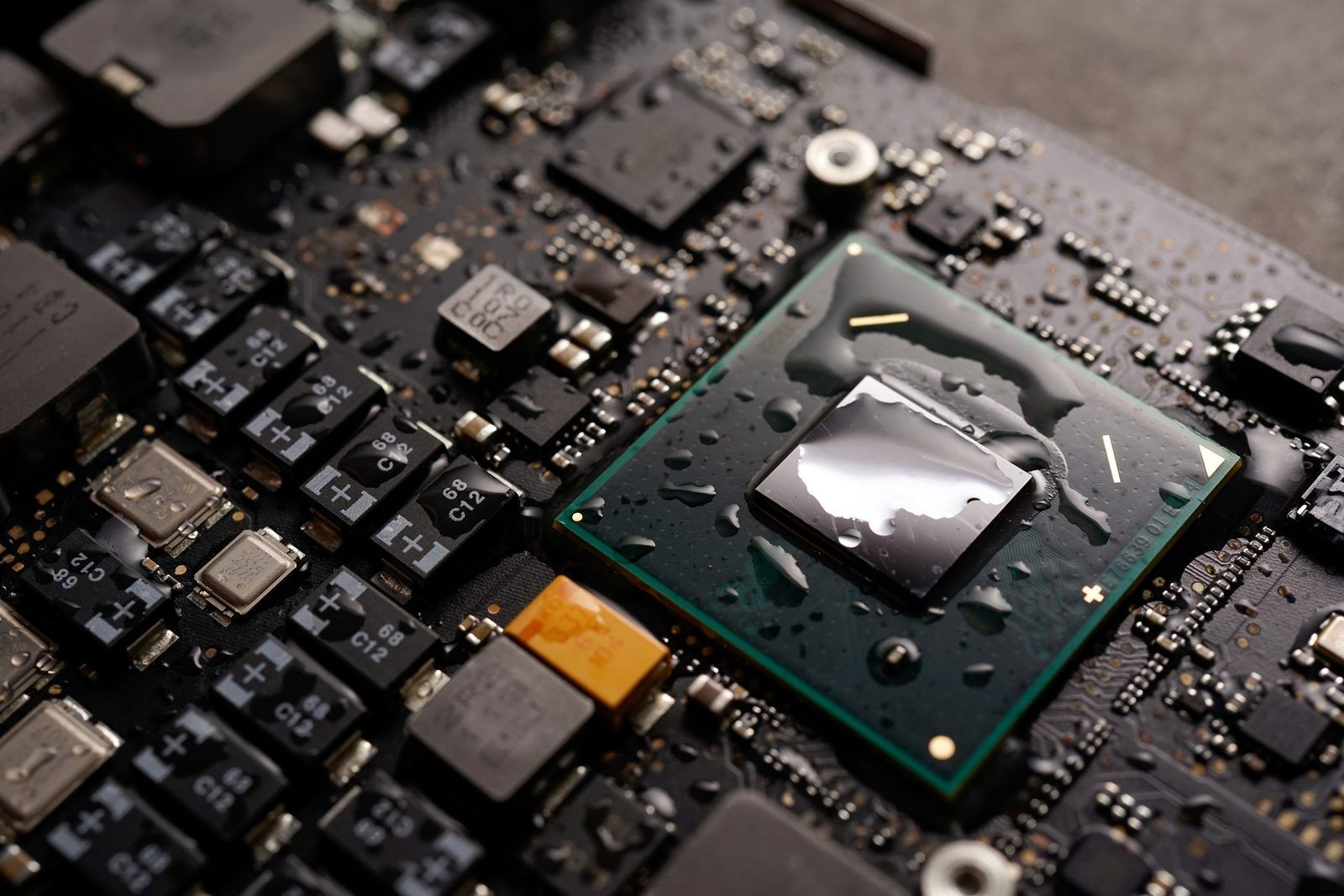
To protect a PCB from condensation, coat it with a material that stays insulating when wet and covers edges and component leads without gaps. Compare the TDS values after water immersion: Bectron® PL 4122-40 E keeps 108 kV/mm against 112 kV/mm dry (IEC 60464-2), and MR 3406 keeps 5 × 10¹⁵ Ω·cm after 7 days in water (TDS 16/12/2009).
Short answer: insulation when wet, coverage without gaps
| Requirement | Datasheet value to look for | Where it is in the TDS |
|---|---|---|
| Insulation stays high when the coating is wet | Volume resistivity or dielectric strength after water storage or immersion | Dielectric properties table |
| Little water taken up | Water absorption, ISO 62 | Chemical properties table |
| Coverage of edges, leads and tall components | Film type (thin or thick) and application method | Product description and processing section |
| A clean, dry surface under the coating | Preparation requirements | Preparation or processing section |
What condensation does on an uncoated board
Condensed water forms a film between conductors. With residues dissolved in it and voltage applied, that film carries leakage current and drives corrosion and migration. The ELANTAS TDSs name these failure modes as what the coating guards against: PT 4600 “provides good protection against moisture, corrosion and migration” (TDS 02/2024, p. 2), and MR 3406 offers “protection against humidity, corrosion vibration and migration” (TDS p. 2/3).
The datasheet value to compare: insulation after water
| Product | Property | Dry / initial | After water | Unit | Method / condition | Source |
|---|---|---|---|---|---|---|
| PL 4122-40 E | Dielectric strength | 112 | 108 after water immersion | kV/mm | IEC 60464-2, 23 °C | Product information 27/02/2024, p. 3 |
| PL 4122-40 E | Volume resistivity | 1 × 10¹⁵ | not stated | Ω·cm | IEC 60464-2, 23 °C | Product information 27/02/2024, p. 3 |
| PT 4600 | Volume resistivity | > 10¹⁴ | > 10¹³ after 7 days water storage | Ω·cm | IEC 60464-2, 23 °C | TDS 02/2024, p. 3 |
| PT 4600 | Surface insulation resistance (SIR) | > 10¹¹ | not stated | Ω | IPC-TM-650 2.6.3.7 | TDS 02/2024, p. 3 |
| PK 4340 | Volume resistivity | > 10¹³ | > 10¹¹ after 7 days water storage | Ω·cm | IEC 60455-2, room temperature | TDS 03/2024, p. 3 |
| MR 3406 | Volume resistivity | 3 × 10¹⁵ | 5 × 10¹⁵ after 7 days water immersion | Ω·cm | Method not stated in TDS | TDS 16/12/2009, Table 4, p. 3/3 |
PL 4122-40 EDielectric strength
- Product
- PL 4122-40 E
- Dry / initial
- 112
- After water
- 108 after water immersion
- Unit
- kV/mm
- Method / condition
- IEC 60464-2, 23 °C
- Source
- Product information 27/02/2024, p. 3
PL 4122-40 EVolume resistivity
- Dry / initial
- 1 × 10¹⁵
- After water
- not stated
- Unit
- Ω·cm
- Method / condition
- IEC 60464-2, 23 °C
- Source
- Product information 27/02/2024, p. 3
PT 4600Volume resistivity
- Product
- PT 4600
- Dry / initial
- > 10¹⁴
- After water
- > 10¹³ after 7 days water storage
- Unit
- Ω·cm
- Method / condition
- IEC 60464-2, 23 °C
- Source
- TDS 02/2024, p. 3
PT 4600Surface insulation resistance (SIR)
- Dry / initial
- > 10¹¹
- After water
- not stated
- Unit
- Ω
- Method / condition
- IPC-TM-650 2.6.3.7
- Source
- TDS 02/2024, p. 3
PK 4340Volume resistivity
- Product
- PK 4340
- Dry / initial
- > 10¹³
- After water
- > 10¹¹ after 7 days water storage
- Unit
- Ω·cm
- Method / condition
- IEC 60455-2, room temperature
- Source
- TDS 03/2024, p. 3
MR 3406Volume resistivity
- Product
- MR 3406
- Dry / initial
- 3 × 10¹⁵
- After water
- 5 × 10¹⁵ after 7 days water immersion
- Unit
- Ω·cm
- Method / condition
- Method not stated in TDS
- Source
- TDS 16/12/2009, Table 4, p. 3/3
| Product | Water absorption | Method / condition | Source |
|---|---|---|---|
| PL 4122-40 E | 1.5 %; 2.5 % | ISO 62; 23 °C, 24 h; 100 °C, 0.5 h | Product information 27/02/2024, p. 3 |
| PK 4340 | 0.9–1.2 % | DIN EN ISO 62, 24 h / 23 °C | TDS 03/2024, p. 3 |
| MR 3406 | 0.05 % | ISO 62, Method 1, 24 h / 23 °C | TDS Table 5, p. 3/3 |
Read per product: PL 4122-40 E keeps 96 % of its dry dielectric strength after water immersion; PT 4600 stays above 10¹³ Ω·cm in volume resistivity after 7 days in water (from above 10¹⁴); PK 4340 stays above 10¹¹ Ω·cm (from above 10¹³); the PT 4600 and PK 4340 values are lower bounds. MR 3406 shows no loss. The four TDSs use different properties and methods, so the table is not a ranking.
Thin film, thick film and hot melt: what each TDS reports
| Item | PL 4122-40 E | PT 4600 | PK 4340 | MR 3406 |
|---|---|---|---|---|
| Type (TDS wording) | Polyurethane varnish based on urethane-modified alkyd chemistry, lead-free, no aromatic solvents | Solvent-free 1K polyurethane thick-film coating, UV and/or moisture cure | 1K polyurethane, thixotropic, for partial or selective coating of SMD groups | 1K polyolefin hot-melt thick-film coating |
| Cure | 16 h at 23 °C; 0.5 h at 80 °C; about 10 min in a regulated in-line oven | UV 5–10 s; moisture in shadow areas 2–3 days | 30 min at 90 °C (ELANTAS recommends 90 °C) or 60 min at 80 °C; IR < 5 min attainable | No cure; solidifies on cooling, normally hard below +100 °C |
| Application (TDS) | Select coat, select spray, automated dipping; manual dipping, brushing, hand spray | Spray, dispensing, jetting, brushing; dipping only in a machine with controlled atmosphere | Dispenser or similar equipment | Hot-melt guns or heated dispensers; 190–200 °C at the nozzle |
| Temperature (TDS) | Temperature index 134 °C (IEC 60216); −40 to +125 °C cycling, > 750 cycles (IPC-TM-650 2.6.7.1 Class 2, as cited) | −40 to +125 °C | Temperature cycling −60 to +125 °C | −40 to +120 °C |
| Rework (TDS) | Solder through the cured coating; remove up to 24 h after curing with AC 93 or Thinner 217 | Not described | Not described | “Very easy re-work as it can be melted and hardened reversibly” |
| UV inspection | “Suitable for inspection of coated areas under UV light” | UV inspection lamps start pre-curing before cure | Not described | Not described |
| UL 94 in the TDS | V0, File E211569 | V-0, File E211569, films of 10–55 µm only | No UL data | No UL data |
Values from the documents listed in the sources: PL 4122 E BLF FLZ 27/02/2024 pp. 2–3; PT 4600 02/2024 pp. 2–3; PK 4340 Schwarz 03/2024 pp. 2–3; MR 3406 16/12/2009 pp. 2–3.
Edge and component coverage: why thick film is chosen
The ELANTAS brochure (version 10/2017, p. 3) describes “Thick Film Coatings for optimum edge covering and fast processing”. That is brochure wording, not a measured value. The TDSs describe how each thick film is placed: PK 4340’s viscosity “increases rapidly” on contact with the object, which “enables precise coating of the designated areas”, and it can form a dam around an area that is then filled with a lower-viscosity grade such as PK 4342 (TDS 03/2024, p. 2). MR 3406 “can be placed selectively to secure and protect single components or for whole PCBs or hybrids” (TDS p. 2/3).
No TDS on hand gives a recommended coating thickness for condensation protection.
Which humidity tests ELANTAS lists
The brochure lists these under “Standard testing @ ELANTAS Europe” (version 10/2017, p. 4). They are test methods ELANTAS runs, not results or approvals for any of the four products above.
| Test | Conditions (brochure) | Methods listed |
|---|---|---|
| Damp heat, constant | +85 °C ± 2 °C at 85 % ± 2 % RH, duration > 168 h | IPC-TM-650 2.6.3.3; IPC-SM-840C Class T |
| Damp heat, cyclic | +25 °C to +55 °C ± 2 °C, 93 % RH (+2/−3 %), 9 h at +55 °C, 9 cycles of 24 h, 3 h temperature change | IEC 60068-2-30; GS 95003-4; VW 801 01; IPC-CC-830B |
| Temperature cycling | −40 °C to +120 °C ± 2 °C, 30/45 min exposure, 100 cycles (500 typical), change < 10 s | IEC 60068-2-14; GS 95003-4; VW 801 01; IPC-TM-650 2.6.7.1; IPC-CC-830B |
None of the four TDSs reports a condensation or cyclic damp heat result. Ask us for the ELANTAS test report of the specific product before you write a humidity test into a specification.
Process traps that cause failures
| Trap | Effect | TDS wording |
|---|---|---|
| Residual washing water | Bubbles in the coating | “Residual water from washing the PCB can cause bubbles so low solids flux or alcohol based cleaning materials are recommended” (PT 4600, TDS 02/2024, p. 2) |
| Flux residue | Poor adhesion | “Use of residue-free flux” (PK 4340, TDS 03/2024, p. 2; MR 3406, p. 2/3) |
| Wet substrate | Bubbles | “The substrate should be dry in order to avoid bubbles of moisture” (MR 3406, p. 2/3) |
| Grease or incompatible materials | Poor adhesion (PK 4340, MR 3406 TDSs) | Components “clean dry and free from grease”, compatibility with all materials on the PCB checked before use (PT 4600, TDS 02/2024, p. 2); compatibility with solder resist and solder paste checked (PK 4340, MR 3406) |
| Fast oven ramp | Bubbles | “Caution is needed to limit the rate of temperature increase to avoid bubbles in the coating” (PL 4122 E BLF FLZ, 27/02/2024, p. 2) |
| UV inspection of wet PT 4600 | Pre-cure, properties not fully developed | “Sunlight or UV inspection lamps will start pre-curing” (PT 4600, TDS 02/2024, p. 2) |
When potting is the better answer
The four coatings above are rated by insulation after water storage or immersion; none of their TDSs claims protection when the assembly is submerged. Where water can collect and stand on the board, potting the assembly is the option to evaluate, and we offer Bectron® potting compounds.
Through the inquiry form, send the board size, the humidity or condensation test you must pass, and your current coating or cleaning process, and ask for the TDSs and samples of the products above.
Questions engineers ask
Does a conformal coating make a PCB waterproof?
None of the four ELANTAS TDSs compared here claims immersion protection. They rate the coatings by insulation after water storage or immersion. Where water can stand on the assembly, potting is the option to evaluate.
Which coating loses the least insulation after water immersion?
Of the four TDSs compared, MR 3406 reports volume resistivity of 3 × 10¹⁵ Ω·cm initially and 5 × 10¹⁵ Ω·cm after 7 days in water, and PL 4122-40 E reports dielectric strength of 112 kV/mm dry and 108 kV/mm after water immersion. They report different properties, so this is a per-product reading, not a ranking.
What humidity test should I specify?
ELANTAS lists among its standard tests damp heat constant at 85 °C / 85 % RH for more than 168 h, and cyclic damp heat from +25 to +55 °C at 93 % RH over 9 cycles to IEC 60068-2-30 (Bectron brochure, version 10/2017, p. 4). These are test methods, not results for a specific product.
Can I check coating coverage under UV light?
The PL 4122 E BLF FLZ TDS lists the coating as suitable for inspection of coated areas under UV light. The PT 4600 TDS warns that UV inspection lamps start pre-curing the wet coating, so do not inspect PT 4600 under UV before the curing tunnel.
Is cleaning required before coating?
Yes. The PT 4600 TDS asks for clean, dry, grease-free components and warns that residual washing water causes bubbles; the PK 4340 and MR 3406 TDSs ask for residue-free flux and dry surfaces.
Application page: Conformal coating