Conformal coating vs potting for power electronics: what the datasheets show
18 October 2026 · Checked against the ELANTAS TDSs for PU 4526 (TDS N°2121 Rev. 4, 12/2024, p. 2–4), PU 4527 (27/05/2008, p. 2–3), PU 4515 (29/08/2016, p. 2–4), SK 75V2-45 (26/04/2017, p. 2–3), PK 4340 Schwarz (N°1893 Rev. 2, 03/2024, p. 2–3), PT 4600 (N°1875 Rev. 2, 02/2024, p. 2–3) and PL 4122 E BLF FLZ (27/02/2024, p. 2–3) on 2026-11-12
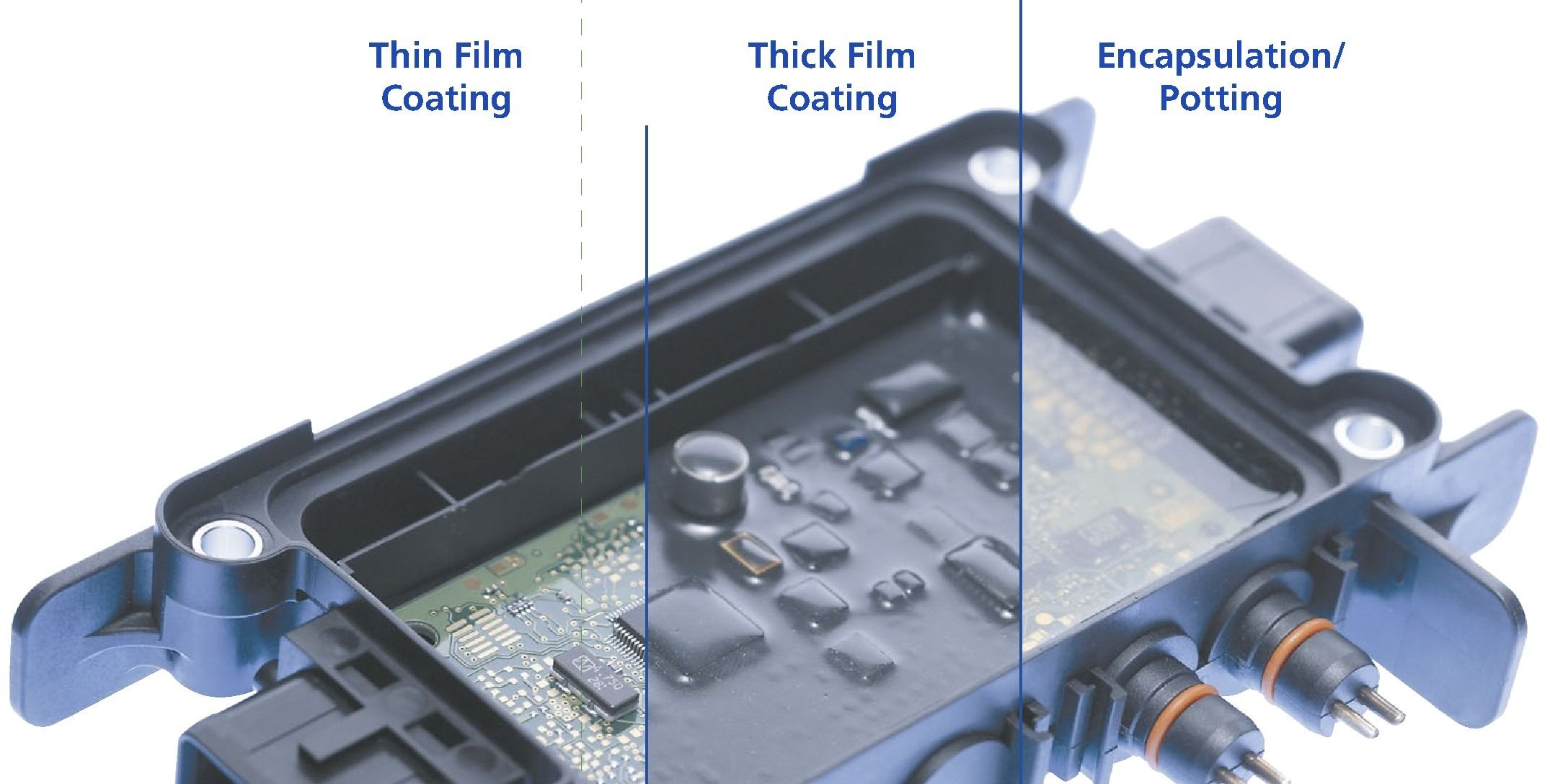
Choose a conformal coating when the main risk is humidity and the board must stay inspectable and repairable; choose potting when it also needs heat transfer, vibration support or insulation in volume. In the ELANTAS Bectron® TDSs, the thick-film coating PK 4340 lists 0.22–0.28 W/m·K; the potting compounds PU 4527, SK 75V2-45 and PU 4526 list 0.54–0.70 W/m·K.
None of the TDSs compared here mentions traction inverters, DC/DC converters, on-board chargers, partial discharge or a voltage class. The tables below give the datasheet values; whether a material fits your insulation design is decided by tests on your assembly, and we review the application with you before you order samples.
Coating and potting side by side
| Product | Type (TDS) | Thermal conductivity | Temperature (TDS wording) | Dielectric strength | UL 94 as stated in the TDS | Source |
|---|---|---|---|---|---|---|
| PL 4122-40 E | Thin-film urethane-modified alkyd varnish, solvent-based | not stated | Temperature index 134 °C (IEC 60216); cycling −40 to +125 °C, >750 cycles | 112 kV/mm (IEC 60464-2) | V0, File E211569 | Product information 27/02/2024, p. 2–3 |
| PT 4600 | Thick-film 1K polyurethane, UV and moisture cure, solvent-free | not stated | −40 to +125 °C | 70–80 kV/mm; 60–70 kV/mm after 24 h in deionized water (IEC 60464-2) | UL 94 V-0, File E211569, films of 10–55 µm only | TDS 02/2024, p. 2–3 |
| PK 4340 | Thick-film 1K polyurethane, thermal cure, thixotropic | 0.22–0.28 W/m·K (DIN 52616, 23 °C) | Temperature cycling −60 to +125 °C | 20–24 kV/mm (IEC 60455-2) | no UL data | TDS 03/2024, p. 2–3 |
| PU 4526 + PH 4912 | 2K polyurethane potting, medium hard | 0.55–0.70 W/m·K (ASTM C 518) | −30 to +130 °C; thermal class B (130 °C) | 22–26 kV/mm (2 mm, ASTM D 149) | UL 94 V-0, File E116643, 5.5 mm | TDS 12/2024, p. 2–4 |
| PU 4515 + PH 4912 | 2K polyurethane potting, polybutadiene-modified | 0.2 W/m·K (DIN 52613) | −60 to +150 °C; thermal index 150 °C (IEC 216) | 33 kV/mm; 22.3 kV/mm after 7 days in water (IEC 60250, as listed) | no UL statement | TDS 29/08/2016, p. 2–4 |
| PU 4527 + PH 4912 | 2K polyurethane, thixotropic, for dam & fill | 0.56 W/m·K (DIN 52613) | not stated | no clear value in the TDS | no UL statement | TDS 27/05/2008, p. 2–3 |
| SK 75V2-45 + SH 79V2-45 | 2K addition-cure silicone, 1:1 | 0.54 W/m·K (method not stated) | −55 to +200 °C | 8.0 kV/mm | “Classified UL 94 V0” | TDS 26/04/2017, p. 2–3 |
PL 4122-40 EThin-film urethane-modified alkyd varnish, solvent-based
- Product
- PL 4122-40 E
- Thermal conductivity
- not stated
- Temperature (TDS wording)
- Temperature index 134 °C (IEC 60216); cycling −40 to +125 °C, >750 cycles
- Dielectric strength
- 112 kV/mm (IEC 60464-2)
- UL 94 as stated in the TDS
- V0, File E211569
- Source
- Product information 27/02/2024, p. 2–3
PT 4600Thick-film 1K polyurethane, UV and moisture cure, solvent-free
- Product
- PT 4600
- Thermal conductivity
- not stated
- Temperature (TDS wording)
- −40 to +125 °C
- Dielectric strength
- 70–80 kV/mm; 60–70 kV/mm after 24 h in deionized water (IEC 60464-2)
- UL 94 as stated in the TDS
- UL 94 V-0, File E211569, films of 10–55 µm only
- Source
- TDS 02/2024, p. 2–3
PK 4340Thick-film 1K polyurethane, thermal cure, thixotropic
- Product
- PK 4340
- Thermal conductivity
- 0.22–0.28 W/m·K (DIN 52616, 23 °C)
- Temperature (TDS wording)
- Temperature cycling −60 to +125 °C
- Dielectric strength
- 20–24 kV/mm (IEC 60455-2)
- UL 94 as stated in the TDS
- no UL data
- Source
- TDS 03/2024, p. 2–3
PU 4526 + PH 49122K polyurethane potting, medium hard
- Product
- PU 4526 + PH 4912
- Thermal conductivity
- 0.55–0.70 W/m·K (ASTM C 518)
- Temperature (TDS wording)
- −30 to +130 °C; thermal class B (130 °C)
- Dielectric strength
- 22–26 kV/mm (2 mm, ASTM D 149)
- UL 94 as stated in the TDS
- UL 94 V-0, File E116643, 5.5 mm
- Source
- TDS 12/2024, p. 2–4
PU 4515 + PH 49122K polyurethane potting, polybutadiene-modified
- Product
- PU 4515 + PH 4912
- Thermal conductivity
- 0.2 W/m·K (DIN 52613)
- Temperature (TDS wording)
- −60 to +150 °C; thermal index 150 °C (IEC 216)
- Dielectric strength
- 33 kV/mm; 22.3 kV/mm after 7 days in water (IEC 60250, as listed)
- UL 94 as stated in the TDS
- no UL statement
- Source
- TDS 29/08/2016, p. 2–4
PU 4527 + PH 49122K polyurethane, thixotropic, for dam & fill
- Product
- PU 4527 + PH 4912
- Thermal conductivity
- 0.56 W/m·K (DIN 52613)
- Temperature (TDS wording)
- not stated
- Dielectric strength
- no clear value in the TDS
- UL 94 as stated in the TDS
- no UL statement
- Source
- TDS 27/05/2008, p. 2–3
SK 75V2-45 + SH 79V2-452K addition-cure silicone, 1:1
- Product
- SK 75V2-45 + SH 79V2-45
- Thermal conductivity
- 0.54 W/m·K (method not stated)
- Temperature (TDS wording)
- −55 to +200 °C
- Dielectric strength
- 8.0 kV/mm
- UL 94 as stated in the TDS
- “Classified UL 94 V0”
- Source
- TDS 26/04/2017, p. 2–3
The dielectric strength column uses five different test methods, so it is not a ranking.
Heat: 0.2 to 0.70 W/m·K
A coating leaves the air gap in the housing as it is; a potting compound fills it. Of the TDSs compared, only the potting compounds and PK 4340 give a thermal conductivity; the PT 4600 and PL 4122-40 E TDSs give none.
| Product | Thermal conductivity | Method | Source |
|---|---|---|---|
| PU 4526 | 0.55–0.70 W/m·K | ASTM C 518, 25 °C | TDS 12/2024, p. 4 |
| PU 4527 | 0.56 W/m·K | DIN 52613 | TDS 27/05/2008, p. 3, Table 3 |
| SK 75V2-45 | 0.54 W/m·K | not stated | TDS 26/04/2017, p. 3 |
| PU 4515 | 0.2 W/m·K | DIN 52613 | TDS 29/08/2016, p. 3, Table 3 |
| PK 4340 | 0.22–0.28 W/m·K | DIN 52616, 23 °C | TDS 03/2024, p. 3 |
PU 45260.55–0.70 W/m·K
- Method
- ASTM C 518, 25 °C
- Source
- TDS 12/2024, p. 4
PU 45270.56 W/m·K
- Method
- DIN 52613
- Source
- TDS 27/05/2008, p. 3, Table 3
SK 75V2-450.54 W/m·K
- Method
- not stated
- Source
- TDS 26/04/2017, p. 3
PU 45150.2 W/m·K
- Method
- DIN 52613
- Source
- TDS 29/08/2016, p. 3, Table 3
PK 43400.22–0.28 W/m·K
- Method
- DIN 52616, 23 °C
- Source
- TDS 03/2024, p. 3
The TDSs name the method but not the specimen, so the ranking across SKUs is indicative.
Temperature range
| Product | Range | What the TDS says | Source |
|---|---|---|---|
| PT 4600 | −40 to +125 °C | “Temperature resistance -40 to +125°C” and “Thermal cycling over -40°C to +125°C” | TDS 02/2024, p. 2 |
| PK 4340 | −60 to +125 °C | “excellent temperature cycling behaviour” within this range | TDS 03/2024, p. 2 |
| PL 4122-40 E | −40 to +125 °C | more than 750 temperature cycles; temperature index 134 °C (IEC 60216) | Product information 27/02/2024, p. 2–3 |
| PU 4526 | −30 to +130 °C | “Operating Temperature Range” | TDS 12/2024, p. 4 |
| PU 4515 | −60 to +150 °C | “devices operating in a wide temperature range” | TDS 29/08/2016, p. 2 |
| SK 75V2-45 | −55 to +200 °C | elasticity and dielectric properties “remain largely stable” | TDS 26/04/2017, p. 2 |
PT 4600−40 to +125 °C
- What the TDS says
- “Temperature resistance -40 to +125°C” and “Thermal cycling over -40°C to +125°C”
- Source
- TDS 02/2024, p. 2
PK 4340−60 to +125 °C
- What the TDS says
- “excellent temperature cycling behaviour” within this range
- Source
- TDS 03/2024, p. 2
PL 4122-40 E−40 to +125 °C
- What the TDS says
- more than 750 temperature cycles; temperature index 134 °C (IEC 60216)
- Source
- Product information 27/02/2024, p. 2–3
PU 4526−30 to +130 °C
- What the TDS says
- “Operating Temperature Range”
- Source
- TDS 12/2024, p. 4
PU 4515−60 to +150 °C
- What the TDS says
- “devices operating in a wide temperature range”
- Source
- TDS 29/08/2016, p. 2
SK 75V2-45−55 to +200 °C
- What the TDS says
- elasticity and dielectric properties “remain largely stable”
- Source
- TDS 26/04/2017, p. 2
The PU 4527 TDS states no temperature range.
Vibration and thermal cycling: what the TDSs state
| Product | TDS wording | Source |
|---|---|---|
| PU 4526 | “very suitable also for electronics subject to shock and vibration (e.g. impact drills and automotive electronics)” | TDS 12/2024, p. 2 |
| PU 4527 | Same wording as PU 4526; also “connecting pins and other key locations subject to corrosion or mechanical stress” | TDS 27/05/2008, p. 2 |
| PU 4515 | “high flexibility and rubber-like properties down to low temperature” | TDS 29/08/2016, p. 2 |
| SK 75V2-45 | elastic properties and long-term thermal resistance for “very sensitive electronic circuits and components operating in very high temperatures” | TDS 26/04/2017, p. 2 |
| PK 4340 | “suitable for vibration protection of delicate components”; temperature cycling −60 to +125 °C “as well as resistance to vibrations” | TDS 03/2024, p. 2 |
| PT 4600 | “good protection against moisture, corrosion and migration as well as vibration” | TDS 02/2024, p. 2 |
| PL 4122-40 E | −40 to +125 °C for more than 750 cycles (“e.g. IPC Test 2.6.7.1 Class 2”, as cited in the TDS) | Product information 27/02/2024, p. 2 |
PU 4526“very suitable also for electronics subject to shock and vibration (e.g. impact drills and automotive electronics)”
- Source
- TDS 12/2024, p. 2
PU 4527Same wording as PU 4526; also “connecting pins and other key locations subject to corrosion or mechanical stress”
- Source
- TDS 27/05/2008, p. 2
PU 4515“high flexibility and rubber-like properties down to low temperature”
- Source
- TDS 29/08/2016, p. 2
SK 75V2-45elastic properties and long-term thermal resistance for “very sensitive electronic circuits and components operating in very high temperatures”
- Source
- TDS 26/04/2017, p. 2
PK 4340“suitable for vibration protection of delicate components”; temperature cycling −60 to +125 °C “as well as resistance to vibrations”
- Source
- TDS 03/2024, p. 2
PT 4600“good protection against moisture, corrosion and migration as well as vibration”
- Source
- TDS 02/2024, p. 2
PL 4122-40 E−40 to +125 °C for more than 750 cycles (“e.g. IPC Test 2.6.7.1 Class 2”, as cited in the TDS)
- Source
- Product information 27/02/2024, p. 2
None of these TDSs gives a vibration test standard, frequency or acceleration.
Flammability: UL 94 V0 only where the TDS states it
- PU 4526: “meets UL 94 V0 standard of flame resistance (File E116643)”; UL 94 V-0 at 5.5 mm (TDS Rev. 4, 12/2024, p. 2 and p. 4).
- SK 75V2-45: “Classified UL 94 V0” (TDS 26/04/2017, p. 2).
- PL 4122-40 E: UL 94 V0, File E211569 (Product information 27/02/2024, p. 3, Table 2).
- PU 4515, PU 4527 and PK 4340: no UL statement in the TDS.
- PT 4600: UL 94 V-0, File E211569, listed for films of 10–55 µm only (TDS 02/2024, p. 3), not for its usual 200 µm film.
- SK 75V2-65: V0 at 5 mm, marked “Internal Test Only” (TDS 26/04/2017, p. 3); it is not a UL listing.
Middle ground: dam & fill and selective encapsulation
| Product | Role | Viscosity | TDS wording | Source |
|---|---|---|---|---|
| PK 4340 | Dam, or selective coating of SMD groups | 8,000–11,000 mPa·s (DIN 53019, D = 15 s⁻¹, 23 °C) | “can be applied as a dam around an area requiring thicker coating to be filled by a lower viscosity grade such as PK 4342” | TDS 03/2024, p. 2–3 |
| PK 4342 | Fill inside a PK 4340 dam | see its TDS | named in the PK 4340 TDS as the lower-viscosity fill | PK 4340 TDS, p. 2 |
| PU 4527 + PH 4912 | Dam & fill, precise lines on pins | 11,000 ± 1,600 mPa·s mixed (DIN 53019, 25 °C) | “special thixotropic flow properties to allow precise dispensing particularly for dam & fill applications” | TDS 27/05/2008, p. 2–3 |
Application notes for thixotropic and 2K materials are on our dispensing page; Naltek supplies the material, not the equipment.
Process time and cure
| Product | Mix ratio | Working / process time | Cure | Before load | Source |
|---|---|---|---|---|---|
| PT 4600 | 1K | — | UV 5–10 s; shadow areas by moisture 2–3 days; last <5 % over 2 weeks | not stated | TDS 02/2024, p. 2 |
| PK 4340 | 1K | — | 30 min at 90 °C (ELANTAS recommends 90 °C) or 60 min at 80 °C; IR <5 min attainable | not stated | TDS 03/2024, p. 2 |
| PL 4122-40 E | 1K | — | 16 h at 23 °C; 0.5 h at 80 °C; about 10 min in a well-regulated in-line oven | not stated | Product information 27/02/2024, p. 2–3 |
| PU 4526 | 100 : 16.6 by weight; 100 : 21.5 by volume | 12–22 min at 25 °C | demould after 7–10 h at 25 °C; optional post-cure 40–60 °C for 10–15 h (suggested 24 h RT + 15 h 60 °C) | not stated | TDS 12/2024, p. 3–4 |
| PU 4515 | 5.0:1 by weight | 14 min | 6–8 h at room temperature, or 1–2 h at 40–60 °C | 3–4 days after room-temperature cure | TDS 29/08/2016, p. 2–3 |
| PU 4527 | see TDS Table 2 | 10 min | 36 h at room temperature, or 2 h at 60 °C | 3–4 days after room-temperature cure | TDS 27/05/2008, p. 2 |
| SK 75V2-45 | 1:1 by weight | about 60 min | about 24 h at room temperature; +10 °C roughly halves the cure time | not stated | TDS 26/04/2017, p. 2–3 |
PT 46001K
- Working / process time
- —
- Cure
- UV 5–10 s; shadow areas by moisture 2–3 days; last <5 % over 2 weeks
- Before load
- not stated
- Source
- TDS 02/2024, p. 2
PK 43401K
- Working / process time
- —
- Cure
- 30 min at 90 °C (ELANTAS recommends 90 °C) or 60 min at 80 °C; IR <5 min attainable
- Before load
- not stated
- Source
- TDS 03/2024, p. 2
PL 4122-40 E1K
- Working / process time
- —
- Cure
- 16 h at 23 °C; 0.5 h at 80 °C; about 10 min in a well-regulated in-line oven
- Before load
- not stated
- Source
- Product information 27/02/2024, p. 2–3
PU 4526100 : 16.6 by weight; 100 : 21.5 by volume
- Working / process time
- 12–22 min at 25 °C
- Cure
- demould after 7–10 h at 25 °C; optional post-cure 40–60 °C for 10–15 h (suggested 24 h RT + 15 h 60 °C)
- Before load
- not stated
- Source
- TDS 12/2024, p. 3–4
PU 45155.0:1 by weight
- Working / process time
- 14 min
- Cure
- 6–8 h at room temperature, or 1–2 h at 40–60 °C
- Before load
- 3–4 days after room-temperature cure
- Source
- TDS 29/08/2016, p. 2–3
PU 4527see TDS Table 2
- Working / process time
- 10 min
- Cure
- 36 h at room temperature, or 2 h at 60 °C
- Before load
- 3–4 days after room-temperature cure
- Source
- TDS 27/05/2008, p. 2
SK 75V2-451:1 by weight
- Working / process time
- about 60 min
- Cure
- about 24 h at room temperature; +10 °C roughly halves the cure time
- Before load
- not stated
- Source
- TDS 26/04/2017, p. 2–3
The current PU 4526 TDS lists “Manual and/or automatic casting/potting” and “Under vacuum casting/potting”, and advises to “avoid thermal variations higher than 10°C/hour” during cure (12/2024, p. 2). The SK 75V2-45 TDS warns that traces of sulphur compounds, amines or tin salts poison the platinum catalyst, so every vessel and line that touches it must be clean.
What to send us
Through the inquiry form, send board size, power loss, operating temperature range, housing and line takt. We reply with the matching TDSs and a sample proposal.
Questions engineers ask
Which Bectron potting compound in this comparison conducts heat best?
PU 4526 at 0.55–0.70 W/m·K (ASTM C 518, TDS 12/2024), then PU 4527 at 0.56 W/m·K (DIN 52613) and SK 75V2-45 at 0.54 W/m·K, according to their ELANTAS TDSs. The thick-film coating PK 4340 lists 0.22–0.28 W/m·K (DIN 52616, TDS 03/2024).
Is every Bectron potting compound UL 94 V0?
No. The PU 4526 and SK 75V2-45 TDSs state UL 94 V0 (PU 4526: File E116643, V-0 at 5.5 mm, TDS 12/2024 p. 4). The PU 4515 and PU 4527 TDSs state no UL rating, and the V0 in the SK 75V2-65 TDS is marked 'Internal Test Only'.
Can a potted board be reworked?
None of the PU or silicone potting TDSs compared here describes rework. The MR 3406 hot-melt TDS states it can be melted and hardened reversibly, and the PL 4122-40 E TDS allows soldering through the cured coating.
How long before a PU-potted unit can be tested?
The PU 4515 and PU 4527 TDSs state that compounds cured at room temperature should not take mechanical or electrical load for 3–4 days. The current PU 4526 TDS (12/2024) instead suggests a post-cure: 24 h at room temperature + 15 h at 60 °C.
Why did my silicone potting not cure?
The SK 75V2-45 TDS warns that its platinum catalyst is poisoned by traces of sulphur compounds, amines or tin salts, which seriously inhibits cross-linking. Vessels, pipes and equipment must be thoroughly cleaned.
Are these compounds rated for 800 V traction inverters?
None of the TDSs compared here mentions inverters, partial discharge or a voltage class. They give dielectric strength and volume resistivity only; suitability for a given insulation design has to be shown on your own assembly.
Application pages: Conformal coating · Potting and encapsulation · Thermal management